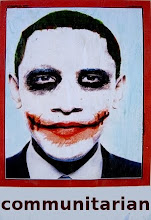
Showing posts with label Tea Party. Show all posts

Friday, November 22, 2013

Tea Party Communitarian By JONATHAN COPPAGE • November 19, 2013

There's a very good reason I've never identified with the Conservative Right. Many Conservatives support the ACL because we publish facts they use. They simply respect our quality of work. Many conservatives are put off because I don't identify myself as a Conservative or a Christian. They ask me to. I won't. If I did, I'd have a lot more readers, supporters, and a lot more promotions. If I were anything, even a Lesbian Democrat, I'd be a lot better off than being what I am. In order to appeal to my countrymen I must wear a label. But I don't identify myself as anything but anticommunitarian, and the American people have yet to become aware of what that means. 
Once I identified the thesis and the antithesis leading to the communitarian synthesis, I became aware of the dialectical roles each "side" plays in promoting the communitarian synthesis. After that I could never participate in any "side" that helps the communitarians. Then we showed with our antithesis how the evidence verifies the transformation of all societies into one big blob. Okay, so I never described it as a "blob," but maybe I should have! People know what that word means.
Today the communitarian synthesis (or blob) is manifesting in the Tea Party. I warned Americans this was going to happen in my Open Letter to Local Tea Party members in 2010. http://nikiraapana.blogspot.com/2010/10/open-letter-to-all-members-of-local-tea.html
Either I have special powers of divination, God told me what to write, or I'm a damn good journalist. Whatever I am, I am the ONLY writer in the world who saw this coming and warned the public about it years before it happened. Now there's a "Tea Party Communitarian"! Oh yeah.

Tea Party Communitarian Can Sen. Mike Lee get libertarian populists to put family first? 

By JONATHAN COPPAGE • November 19, 2013
Article re-posted in its entirety from The American Conservative website http://www.theamericanconservative.com/articles/tea-party-communitarian/:
Mike Lee is an unlikely candidate for conservatism’s most promising policy mind. A Tea Party firebrand since he swept into office in 2010, Lee was the driving force behind efforts to defund Obamacare that led to a 16-day government shutdown this October. Yet the past year has also seen him reveal another side to his populist conservatism: a communitarian agenda for policy reform.
At the American Enterprise Institute in September, Lee set out a tax-reform proposal centered around a per child tax credit that would apply to income and payroll taxes alike. At the unveiling, Lee said: “Now, if you are like me—a conservative with a libertarian streak—you might at first raise an eyebrow at all this. My plan, you might say, may share some features of traditional conservative tax reform but it’s no flat tax. It’s no consumption tax,” two policies long favored by conservative for their economic efficiency or ostensible fairness.
“That’s right,” he continued. “It’s better.”
With the slightest hint of braggadocio that only a humble Utahn can muster, Lee broke with the economic individualism of the conservative establishment to prioritize instead the family, “the first and foremost institution of civil society.” There was a sound economic basis for this, to be sure. Lee drew attention to what he called the “Parent Tax Penalty” whereby parents doubly contribute to entitlement programs through their taxes and the expenses they incur raising future taxpayers. And he insisted, “Here, I am not speaking about the family as a moral or cultural institution, strictly as a social and economic one.” But that in itself is significant: the family, not just the individual, is what economics must be about.
“Conservatives sometimes get criticized for putting too much emphasis on the family in policy debates,” he acknowledged. But “the real problem may be that we don’t think about the family enough. For family is not just one of the major institutions through which people pursue happiness. Is the one upon which all the others depend.”
At the Heritage Foundation in April, Lee delivered a communitarian manifesto of sorts entitled “What Conservatives Are For.” He emphasized “that the true and proper end of political subsidiarity is social solidarity” and explained that his “vision of American freedom is of two separate but mutually reinforcing institutions: a free enterprise economy and a voluntary civil society.”
Lee’s proposals focus on relieving burdens on the institutions that strengthen society in their everyday practice. This outlook goes straight back to his Utah origins. “We’ve always been a state that has had strong institutions of civil society, very strong neighborhoods, very connected neighborhoods where people know each other,” the senator tells me. “Sometimes people are quick to assume that that just refers to people who are members of my church, the Church of Jesus Christ of Latter-Day Saints, but it’s not just that. There’s a very strong neighborhood dynamic in Utah that perhaps traces back to the way we were settled,” he explains.
“People had traveled great distances, sometimes thousands of miles to get there to what was initially a fairly desolate desert. The Salt Lake Valley was said to only have one or two trees when the first Mormon Pioneers arrived in 1847, and it required people to work together a lot to build these communities, to make the desert blossom like a rose. And that has become part of our culture, and it has thrived.”

{Niki ads this link here: Mormon Communitarianism- Distinct by Eschatology
Communitarian concern for the social fabric and libertarian resistance to big-government interventions fit together naturally for the Utah senator. “Lee has been eager to show that social conservatism and concern for the family doesn’t speak a different language than his kind of constitutionalism and limited government-ism,” says Yuval Levin, editor of the policy quarterly National Affairs. Levin is encouraged by the direction he sees leaders like Lee taking.
“I think there’s been a tendency for a decade or more in conservatism to move away from communitarian talk to a much more individualist talk, and it’s very much in need of counterforce,” he says. “Conservatism needs to be a counterweight to radical individualism, not an enabler of it, and to me to see that being expressed again is really crucial.”
At AEI, Lee opened his proposal by speaking of “a new and unnatural stagnancy” that has trapped the poor and worn down the middle class. There are the beginnings here of a different way of talking about the economy, in contrast to the GOP’s old prosperity gospel for the upwardly mobile. Republicans a year ago proved all too ready to fan the flames of upper-class resentment with talk of the 47 percent of Americans who pay no federal income tax. Lee rebukes that mentality, pointing out at AEI that “people who pay no income tax do pay federal taxes—payroll taxes, gas taxes, and various others,” and squarely declaring, “Working families are not free riders.” Web issue image
Lee rails upward instead, against the cronyism that big government and big business together have cultivated at the taxpayer’s expense. “At the top of our society, we find a political and economic elite that—having reached the highest rungs—has pulled up the ladder behind itself, denying others the chance even to climb,” he warned at AEI. At Heritage, he went so far as to say, “The first step in a true conservative reform agenda must be to end this kind of preferential policymaking. Beyond simply being the right thing to do, it is a prerequisite for earning the moral authority and political credibility to do anything else.” How, he asked, could working families take seriously a conservatism that props up and subsidizes big banks and corporate agricultural interests?
For a GOP long seen as the party of entrenched financial interests, populist credibility must be won back, and a deregulation agenda alone won’t cut it. This is where Lee’s rugged communitarianism is especially vital to his cause. In his Heritage speech, he described the conservative vision as “not an Ayn Rand novel. It’s a Norman Rockwell painting, or a Frank Capra movie: a society of ‘plain, ordinary kindness, and a little looking out for the other fellow, too’. ”
He continued,
In the last few years, we conservatives seem to have abandoned words like ‘together,’ ‘compassion,’ and ‘community’ as if their only possible meanings were as a secret code for statism. This is a mistake. Collective action doesn’t only—or even usually—mean government action. Conservatives cannot surrender the idea of community to the left, when it is the vitality of our communities upon which our entire philosophy depends.
Lee’s understanding of civil society redirects what often seems like a pure populist backlash—a mere reaction—to finding constructive ways in which limited-government constitutionalists can act on James Madison’s notion that government is for “the happiness of the people” and Abraham Lincoln’s idea that it ought “to lift artificial weights from all shoulders, to clear the paths of laudable pursuit for all.”
But can Lee sell his communitarian message to his fellow constitutionalists? Levin is hopeful: “He has a shot because to a certain extent he’s filling a vacuum, and that means he really has an opportunity to shape the arena the way he wants to.”
As Lee himself said at AEI: “For a political party too often seen as out of touch, aligned with the rich, indifferent to the less fortunate, and uninterested in solving the problems of working families, Republicans could not ask for a more worthy cause around which to build a new conservative reform agenda.”

Thursday, November 25, 2010

The communitarian's "Tea Party" paranoia

The communitarians are freaking out because Americans are finally challenging Agenda 21. I didn't realize how many people were going to their local agenda 21 meetings and asking direct questions about the plans. The LAST thing LA21 planners want or need is a room full of Americans asking them for definitions of legal terms, authority of law, grant sources for pilot tests and developments and other such "nonsense."

This is fantastic news and gives me a reason to give thanks today! For the first time in almost eleven years I have hope that the communitarian agenda for reinventing American government will go public, be debated (legitimately) and finally go before ALL the voters who pay for it.

Why are communitarians so quick to sling mud in the faces of Americans who want to know more about Local Agenda 21? Because American voters were never told anything about it. Our people were never supposed to have any voice in the decision to implement it. And, up until now, we didn't. The irrefutable FACT of this whole matter is the same as it's been since I first uncovered it in Seattle in 1999: most Americans have never heard anything about it, not even the ones who participate in passing the plans! LA21 changes our entire legal system and anyone who asks where the authority for doing that comes from is a nutcase? Yeah right.

Here's the communitarian's idea of damage control: Insult your opponent and hope that deters others from thinking they have any right to answers. Slander them, mock their education, ridicule their lifestyle, dis their culture.. whatever is easiest to identify. Show zero respect for their nation, their laws or their customs. Violate their space, threaten their livelihood, bribe, steal, trick, deceive, lie, cheat, sneer, yawn, disrupt, stalk, terrorize... it's all okay because the ends justifies the means.
The Tea Party Targets... Sustainable Development? If you believe conservative activists, smart growth is really a global conspiracy to herd Americans into "human habitation zones." By Stephanie Mencimer http://motherjones.com/politics/2010/11/tea-party-agenda-21-un-sustainable-development?page=2

"The scene in Maine is repeating itself across the country. Only sometimes the activists are less polite. One planning consultant I spoke with, who requested anonymity, recalled a recent meeting where he was on the receiving end of tea party rage. "I got called a communist," he says. Someone in another tea party-heavy area recently told him, "We don't need none of that smart growth communism." The people he's been encountering are new to the process, short on solid facts, and many are "spitting mad." Combined with what they see as an "elitist" bent in planning consultants, he says, it makes for a toxic and intimidating mix for local officials who aren't used to being accosted by conspiracy theory wielding activists."
For the past ten years I've heard the claim that UN Local Agenda 21 is a conspiracy theory. It never seemed to matter that the document exists and that America is being modified to adopt its principles. The term conspiracy theorist is thrown out EVERY TIME an average American citizen asks a legitimate question about the plan to rebuild America into communities. And no matter who responds, the questions are never answered honestly, and insults are all we hear.

Isn't it amazing how many different ways communitarians can skirt direct questions? It must be part of their academic training because they all use the same meaningless insults no matter what kind of people they're confronted by. Anyone outside the "development loop" who shows even the slightest interest in questioning the validity of UN sustainable development is a: tin foil hat, conspiracy theorist, paranoid obstructionist, credulous fool, ignorant back woods hick, mad hatter, wing nut, terminally moronic, white racist, Nazi thug, 2oth century Neanderthal, etc, etc.

The Tea Party's "livability" paranoia, by Jonathan Hiskes, 23 Nov 2010 5:23 PM
http://www.grist.org/article/2010-11-23-the-tea-partys-livability-paranoia

I am not a right wing conservative, I am not a Libertarian and I didn't vote for Ron Paul, but I did send out a letter to the Tea Party asking them to consider making communitarian community development one of their issues. While my "open letter" may have only reached a very small percentage of those members, it's entirely possible I had something to do with putting LA21 on the Tea Party's agenda. Maybe that's why one of my readers told me I've reached millions of people through my work. Nordica and I laughed at that... we just did a count of how many books we've sold and joked about putting "Over 400 copies sold!" on the new cover. I am going to work my butt off to get the new books ready asap... we can certainly fill in those "short on solid facts" areas for some people. This is why understanding the communitarian philosophy and system of LAW is so necessary to seeing the truth about SD.... otherwise objecting to it makes no sense. We have to decide on whether to adopt the principles as well as the plans.

Happy Thanksgiving from our house to yours. We're fortunate enough to have a ham and some fixin's, and we hope you are too. Might just turn on the piano and pretend we're at my moms too. Our family always started rehearsing for Christmas after Thanksgiving dinner. Been many years since we were all together for the holidays... the last time I sang Christmas carols with my sisters and my brother was during a family reunion in 1998.. in August. Ever since I began researching LA21 I stopped enjoying a full life. I'm thinking of happier times today.

Tuesday, November 16, 2010

Etzioni praises autocracy as efficient, blames "democracy" for our nation's woes

Dr. Amitai Etzioni bills himself as the "everything expert"... because he knows more than any other Israeli just about everything there is to know about terrorism and the need for building a safer global military police state.

"If I were an actuary selling insurance for death by asteroid or death by terrorism, I'd charge about the same premium for either one." Alan W. Harris
Senior Research Scientist, Space Science Institute

In an opinion piece at CNN today, Amitai Etzioni poses the Tea Party against the Fed:
http://www.cnn.com/2010/OPINION/11/16/etzioni.fed.teaparty/

Here's Etzioni's moral argument in favor of TSA full body scanners:
http://www.tnr.com/article/politics/78250/private-security-virtual-strip-search?page=0,1

Did Etzioni really say we should bomb Iran back to the Stone Age?
http://www.iranian.com/main/blog/babaksabzevari/bomb-iran-back-stone-age-u-s-army-journal-cover-story

Did Etzioni really say we should bomb Iran's civilian infrastructure:
http://tpmcafe.talkingpointsmemo.com/2010/06/24/etzioni_time_to_bomb_irans_civilian_infrastructure/

Etzioni seems to be less subtle about his true intentions in the Israeli press;
http://www.haaretz.com/blogs/focus-u-s-a/focus-u-s-a-the-u-s-will-have-to-confront-iran-or-give-up-the-middle-east-1.297931

Here's Etzioni's feelings about (goyim?) civilian casualties:
http://www.tnr.com/article/politics/magazine/76426/afghanistan-war-troops-taliban

"The notion of engagement and turning another cheek is a wonderful idea, it’s just not working.” Former Israeli terrorist Dr. Amitai Etzioni on the futility of Western Christian values.

“Gentiles need to die….goyim have no place in the world.” Rabbi Ovadia Yosef, founder of the Shas Party, part of the Likud coalition headed by Prime Minister Benjamin Netanyahu
http://www.veteranstoday.com/2010/10/20/gordon-duff-israeli-rabbi-gentiles-need-to-die/

"Etzioni was on a panel in our temple about a year after 9/11. I was so excited because I had read his work during my sociology graduate program.

Wow was he a disappointment! He was on with Chertoff (Chertoff was then working at Homeland Security under Ridge) and he lied more than Chertoff did.
For example, in talking about people rounded up, hauled in for questioning and detained after 9/11, he claimed that it was no big deal and that the longest anyone had been held without contact was 3 hours! Chertoff said nothing and actually looked uncomfortable.
Etzioni was vitriolic and hateful and totally closed to any opinions other than his own.
So I'm hardly surprised by his proposal to bomb Iran. Posted by Tamarat June 24, 2010 10:21 AM

Amitai Etzioni, CFR, participates in the
The United States and the Future of Global Governance Roundtable Series
http://www.cfr.org/project/1379/united_states_and_the_future_of_global_governance_roundtable_series.html

The McGraw-Hill Homeland Security Handbook cites Etzioni (next to Shaw!):
http://www.homelandsecuritybook.com/book/section-12---domestic-counterterrorism-and-civil-liberties.html

HARRIS ON TERRORISM AND ASTEROID RISKS
For terrorism deaths I referred to the following web site:
http://www.johnstonsarchive.net/terrorism/intlterror.html
Using statistics compiled by the U.S. Department of State for international terrorism, I tally up an average of about 1,000 deaths per year over the eight years between 1997 and 2004. This includes the one big spike of 9/11, but enough other years to smooth it out to less than half the total. Without 9/11, it would be around 600 per year. So, taking a life span to be 80 years and the population of the world to be 6 billion, we have the chance of death by terrorism in a lifetime to be one in (6 billion)/(80,000), or about one in 75,000. I rounded to 80,000 since the number is at least that uncertain. Note that this process essentially assumes that, in addition to the usual number of deaths from international terrorism, there will be a 9/11-type catastrophe somewhere on the globe every several years. Excluding 9/11 and such repeats, the probability becomes about one in 120,000.

For the asteroid risk, I referred to the NASA report of a few years ago that I participated in (so the numbers are somewhat my own). The publication can be found at: http://neo.jpl.nasa.gov/neo/report.html
In that report, we estimate a "nominal" risk from asteroid impacts of about 1,300 deaths/year from all sizes of impacts. That translates to about one in 60,000 using the above population of the planet and human lifetime. However, we are discovering NEAs (near-earth asteroids) all the time, and with each asteroid discovered and certified not to be on a collision course in our lifetimes, the short-term risk (in the next 100 years or so) is reduced. So far we have retired about half the total risk, so it is arguably only about one in 100,000. However, you will see in the report that the range of uncertainty is a factor of several, so it is reasonable to say that the
risk is in the same range as from terrorism, in the general range of one in a hundred thousand.
We know they are out there, we can count them in our telescopes, and we know statistically how often they hit the Earth. We know roughly the statistical probability of any one hitting the Earth, however there is considerable uncertainty concerning the consequences of an impact of a given size. However, other than this uncertainty, the rest is pretty hard fact, even if we have never experienced it even once.

In both cases, the odds vary by region. In the case of terrorism, the most dangerous place to live is in the Middle East. In the case of impact hazard, most dangerous is living along an exposed shoreline where an impact-generated tsunami might get you.
If I were an actuary selling insurance for death by asteroid or death by terrorism, I'd charge about the same premium for either one. The only difference is, with terrorism I'd probably have to pay up a small amount every year. With the asteroid, we'll all go together and I won't be around to pay up.

Alan W. Harris
Senior Research Scientist
Space Science Institute
4603 Orange Knoll Ave. 818-790-8291
La Canada, CA 91011-3364 awharris@SpaceScience.org
From JOHN MUELLER: OVERBLOWN
http://polisci.osu.edu/faculty/jmueller/overblown.html

Tuesday, October 5, 2010

An open letter to all members of local Tea Parties

An open letter to all members of local Tea Parties
from the co-founder of the Anti Communitarian League


Every policy the Tea Party has protested is based entirely in communitarian ideology. From National Health Care to the Bank Bailout to the Stimulus Package to Stop the IRS and End the Fed, it's all communitarian. Yet the actual word, communitarianism, is missing from your protests and debates. Our entire country is being led down a communitarian path without any idea of how it's happening. So, I'd like to present it to you as a topic for discussion.

This is not an attempt to take-over or co-opt your party. I have zero aspirations for political or leadership positions. Simply bringing the topic of communitarian development before American voters has been the driving force behind everything I've written about it for the past ten years. My primary goal is to make the changeover to communitarian government open to public debates in every affected country.

Communitarianism is the belief that individual and national sovereignty must be balanced against the needs of the global collective. Their entire foundation for forced social evolution rests on their Big Idea that all the world's people will be "free" after everyone gives up any claims to their personal freedom. Defined as the new "spirit" of community, Communitarians believe they are leading mankind into an advanced moral and spiritual state of being. Across the globe, communitarian gurus promote a global program designed to create one big, planned, gated community. They call it sustainable community development.

Anti communitarianism is the antithesis to communitarianism. That means we think the opposite of communitarians. We disagree with their Big Idea. We oppose forced social evolution. We disrespect their organizations. We object to communitarian programs, policies, and laws being enforced upon nations that have not legally adopted supremacy of communitarian law. We hate what they've done to America.

The Anti Communitarian League began in Seattle, Washington in the spring of 1999. We were renters who became targets in a huge land war between the community planners and our wealthy landlord. I spent three years volunteering my time to help "slumlord" Hugh Sisley resist hostile, "innovative" government land use actions against him and his tenants. (Sisely and the City won; We the Tenants lost.)

The City of Seattle and King County government had established new agencies with new agency rules. These offices were granted expanded power to write and enforce new judicial administrative regulations. Their new laws supposedly completely overruled our 4th and 5th Amendment Rights. When we complained and insisted on a Redress of Grievances, City officials told us our rights had already been balanced against the "rights of the community at large." When they could not provide evidence for this drastic change to U.S. Rule of Law, I began reading everything about it that I could find .

I learned very quickly that this wasn't just an ordinary local land dispute. It was apparent to me that we were on the front lines of a massive multi-front war against our individual, state and national freedom.

It took me a full year of reading before I identified the replacement system driving the new actions. American officials rarely tell American voters the name of the new system. The Reinvention of America into a Sustainable Communitarian Paradise was never supposed to be debated or voted upon by the American people. By the time we found out about it, it was, according to our officials, already a "done deal."

In the beginning I was still naive enough to think lots of other Americans would join in our fight. I asked everyone I saw if they knew the Bill of Rights had been replaced with communitarian values. Most of them laughed right in my face. I wrote hundreds of snail mail letters and spent thousands of hours studying, reading, and hoping someone more qualified would take over the resistance. I was shocked to learn we were the only anti communitarians in the United States. I remain horrified by the fact that every university in the country teaches communitarianism yet our original thesis against it is the only one ever written.

A lengthy study of the recently available online documents about your party shows me that your loosely affiliated organizations have not taken an official position on the philosophy that drives the Reinvention of American Government. I've found a few local groups that have posted information about UN Local Agenda 21 and Sustainable Development. I haven't found any local Tea Party groups (besides affiliates of Gigi Bowman in NY) who are being asked to discuss or vote on communitarian changes to the U.S. system.

Since my above definition of anti communitarian thinking is based entirely in my own personal research, experience and understanding, it's only fair to provide you with a short synopsis of who I am and how I came to be an anti communitarian thinker.

In the early 80s while I was attending college in Anchorage, Alaska (and bartending nights at Whitekey's Fly By Night Club) I became a registered Libertarian voter. My friend Kenzo and I even attended a fund raiser for Dick Randolf and won a lunch "date" with Ed Clark. Having read Atlas Shrugged in the sixth grade, I thought I knew what the Libertarians stood for.

When I transferred to UMAss, Amherst in 1984, I did deep background research on U.S. policies toward the Sandinistas and found myself opening up to socialism. After writing two extra credit documentaries on U.S. Economic Policy in Central America, I began identifying my politics as Libertarian, Socialist & Feminist, and later added Green to my list. (I never identified with either the Democrats or the Republicans.)

I think I clicked with the Libertarians because I was convinced they represented individual liberty. My freedom to move whenever I want to move on means everything to me. But I also come from German Wisconsin farm stock and have a deep respect for people who work the land. I admired the socialists because I thought they represented land starved Nicaraguans against the arable land gluttony of the ruling Somoza family. I grew up on Steinem and Bella and had always considered myself a feminist. I love camping and being in the woods, so I naturally assumed that's what being a Green was all about.

It was only after I began fighting the new community development policies in 1999 that I did a thorough vetting of all my political beliefs. What I learned was most difficult to swallow.

My first realization was that the Libertarian Party was unwilling to step up and debate the communitarians, even after Washington Post columnist E.J. Dionne wrote that the "last great debate" in American politics was between the Libertarians and the Communitarians. I later realized the party's founders were internationalists promoting free market/free trade communitarianism in the United States.

My second realization was that Bella signed the Communitarian Platform. Feminism, as it turns out, is just another dialectical branch of communitarianism.

My third big realization was the role socialism plays in the phony dialectical evolution into communitarianism. Socialism, like capitalism, exists only to further the communitarian synthesis.

The Green Party ended up being number two on my enemy list, the first place reserved forever for their ideological affiliate Dr. Amitai Etzioni, founder of the Communitarian Network.

By 2002 I decided I would only vote for candidates who defend the U.S. Bill of Rights by openly attacking communitarian policies in the U.S.. Obviously I've never voted since then.

Focusing mainly on The Communitarian Reinvention of American Government under Presidents Clinton and Bush II, some of my ACL research was devoted to minor communitarian Third Way politicans like Senator Evan Bayh. I did make note of Senator Barack Obama's introduction as the Third Way Wonder Boy in 2004. All I needed to know about Obama when he ran for president was the fact that Communitarian Platform signer Professor John McNight also signed Obama's Harvard Law School application.

It was during the 2008 elections that I became acquainted with some people who supported Ron Paul. When I was unable to find Congressman Paul using the word communitarianism once in all his years of published speeches against the U.N. Agenda, and his office never responded to my inquiries, I refused to endorse him on my websites. The ACL has endorsed only a couple of candidates in our entire time online, and one's a Canadian. When the Ron Paul Revolution became the Tea Party protests, I didn't join, but I was happy to see the turnouts. I was relieved that our people were finally showing some gumption.

I am now convinced your smallest local groups are in the position of taking any political direction the members choose to take. Maybe once your members are introduced to their enemies as communitarian thinkers, you can stop everyone else and their brother from defining what it is you stand against.
"Vast forests have already been sacrificed to the public debate about the Tea Party: what it is, what it means, where it's going. But after lengthy study of the phenomenon, I've concluded that the whole miserable narrative boils down to one stark fact: They're full of shit. All of them." http://www.rollingstone.com/politics/news/17390/210904
According to the Communitarians, the U.S. Constitution (and all national government) is "outdated" and poses a barrier to achieving world peace and justice. This appears to be in direct opposition to your principles:
“There already is a universally accepted national tea party statement and a national tea party platform. We've had them for a long time. The national tea party statement is called the Declaration of Independence, and the national tea party platform is the Constitution of the United States. And come to think of it, I can name six or seven national tea party leaders—revered figures who command the movement's loyalties. Their names are among those signed at the bottom of our national tea party statement and our national tea party platform. They are John Hancock, Thomas Jefferson, John Adams, Benjamin Franklin, George Washington, James Madison." Tea Party Declaration of Independence from Political Party Loyalties By Paul Beaird March 23, 2010
There are several indications your party is being misled and co-opted by communitarians.

1. Some people are already calling you communitarians:
"They're what I call "molecular," or communitarian, individualists -- that is, individuals cooperating with others to achieve what the politicians promise but can't deliver." http://www.thenews.com.pk/03-10-2010/opinion/7993.htm
2. Branches of your movement are tricking you into supporting Right Wing Conservative Communitarians like Palin and Beck:

Sarah Palin, Tea Party darling, targets Democrats backing 'Obamacare' on website 'Take Back the 20' http://www.nydailynews.com/news/politics/2010/09/24/2010-09-24_sarah_palin_tea_party_darling_targets_democrats_backing_obamacare_on_website_tak.html

3. Communitarianism is a social science that infiltrates national and state governments via social development programs. It's called Socio-Economics. Why would Tea Party members discount it as an issue?
"This is not a movement based on social issues," Melanie Morgan, a former talk show host who has been active in Tea Party Express, told USA TODAY earlier this year. "Many conservatives are involved only because of the fiscal aspect of smaller government, of lower taxation, of an accountability as far as the debt is concerned, the runaway spending by the liberal Congress." http://www.usatoday.com/news/politics/2010-09-20-values20_ST_N.htm
4. The Left Wing Communitarian President of the United States is using Right Wing Communitarian Shills and Rolling Stone Magazine to slander you as corporate backed phonies:
RS: What do you think of the Tea Party and the people behind it?

Obama: I think the Tea Party is an amalgam, a mixed bag of a lot of different strains in American politics that have been there for a long time. There are some strong and sincere libertarians who are in the Tea Party who generally don't believe in government intervention in the market or socially. There are some social conservatives in the Tea Party who are rejecting me the same way they rejected Bill Clinton, the same way they would reject any Democratic president as being too liberal or too progressive. There are strains in the Tea Party that are troubled by what they saw as a series of instances in which the middle-class and working-class people have been abused or hurt by special interests and Washington, but their anger is misdirected.

And then there are probably some aspects of the Tea Party that are a little darker, that have to do with anti-immigrant sentiment or are troubled by what I represent as the president. So I think it's hard to characterize the Tea Party as a whole, and I think it's still defining itself.

RS: Do you think that it's being manipulated?

Obama; There's no doubt that the infrastructure and the financing of the Tea Party come from some very traditional, very powerful, special-interest lobbies. I don't think this is a secret. Dick Armey and FreedomWorks, which was one of the first organizational mechanisms to bring Tea Party folks together, are financed by very conservative industries and forces that are opposed to enforcement of environmental laws, that are opposed to an energy policy that would be different than the fossil-fuel-based approach we've been taking, that don't believe in regulations that protect workers from safety violations in the workplace, that want to make sure that we are not regulating the financial industries in ways that we have.

There's no doubt that there is genuine anger, frustration and anxiety in the public at large about the worst financial crisis we've experienced since the Great Depression. Part of what we have to keep in mind here is this recession is worse than the Ronald Reagan recession of the Eighties, the 1990-91 recession, and the 2001 recession combined. The depths of it have been profound. This body politic took a big hit in the gut, and that always roils up our politics, and can make people angry. But because of the ability of a lot of very well-funded groups to point that anger — I think misdirect that anger — it is translating into a relevant political force in this election. http://www.rollingstone.com/politics/news/17390/209395
5. Obama's and the RS writer's opinion seems to be completely at odds with average people's opinion within the movement:
"Obama could not be more wrong — in fact, his thinking shows a lot more about his problems than the tea party’s. If the Tea Party is being run by special interest lobbies, then our special interest lobbies are in a lot of trouble. The convention was held at the Mill Valley community center. There were about 500 people there; it was standing room only. They spent the whole day milling about between different tables that represented various groups, ranging from the NRA to the seller of a cookbook of “conservative recipes.” I didn’t look, but I assume it was full of recipes for meatloaf and mashed potatoes with nary a sprig of endive in sight. There were funny T-shirts, cut-outs where you can get your picture taken next to Lincoln, Reagan, or Palin, and lots of sugary foods from Costco.

It was all very unprofessional, by which I mean that it did not seem the least bit stage managed or fake, in the way that the events put on by professional political operatives usually are. It was all quite spontaneous. Here’s an example. The speakers were unorganized, and had to speak in the hall in competition with all of the tables. So if people were not interested in a speaker, they would just go on buying and selling books and T-shirts or signing up for petitions, and eventually the speaker would be drowned out. If they were interested, the chatter would stop and eventually people would stop and listen. It was, in a charming way, the competition of the free market of ideas at work. http://www.libertycentral.org/president-obama-is-wrong-about-the-tea-party-2010-10

JakeSense, 19 September 2010 12:30AM said, Please stop repeating the lie that Tea Party members are "Conservatives". Numerous polls in the US consistently show that almost half of people who identify with the Tea Party -- myself included -- are Liberal Democrats. The Tea Party has one, and only one goal -- Fiscal Responsibility. Just because some fools (Sarah Palin and Glen Beck) are trying to co-opt the Tea Party does not make any the rest of us Conservative. We can disagree vehemently with Palin and Beck, yet still think the government must learn to balance it's budget, stop piling on so much debt and the Federal government spending is out of control.
http://www.alternet.org/story/148206/this_country_just_can%27t_deal_with_reality_any_more
6. Communitarian Radicals think they are the experts on what you really mean:
"When tea party activists say they want to change Washington, what they mean is, they want to get rid of politics." http://perspectives.thirdway.org/?p=874
I realize "forests" have already been cut down trying to explain your Tea Party. There appears to be a few solid and agreed upon principles behind it, but every description of what you represent incorporates the writer's personal views and political beliefs into their definition of you. From Obama down to each local group online, the Tea Party is whatever you want it to be. Now that I fully grasp that amazing truth, may I humbly suggest you consider adding anti communitarianism to your local group's discussion list next time you meet up?

Sincerely,
Niki Raapana
Anti Communitarian League
http://nord.twu.net/acl

Wednesday, August 18, 2010

"The tea partiers are half right" CNN- by Amitai Etzioni

Someone from George Washington University looked up "Amitai Etzioni" and ended up at our page about him at the ACL. I took a peek at the google results for his name and found this.

The tea partiers are half right,

By Amitai Etzioni, Special to CNN,
August 2, 2010 --
http://www.cnn.com/2010/OPINION/08/02/etzioni.tea.party/index.html

Thursday, May 13, 2010

Is Rep. Paul Ryan an anti-communitarian?

Here's something interesting that came up today. Derek Thompson wrote an article for the Atlantic about a New Republic writer's article "blasting Rep. Paul Ryan and his anti-communitarian ilk," but, the NR writer (Jonathan Chait) never used the word communitarian or anti-communitarian in the referred to article. What Chait did write about Ryan was even more revealing, and their phony game couldn't be more obvious to a real anti communitarian like myself.

Rep. Paul Ryan is an objectivist following Randian dialectical principles. Derek and Jonathan follow Marxist dialectical principles. Anti-communitarians object to the Hegelian dialectical process that leads to the final communitarian synthesis. We do NOT endorse dialectical debates, and we stand firm in opposition to the "perfect" communitarian synthesis (which renders it imperfect!) As the leading anti-communitarian thinker in the world, I think I can speak with some authority on this subject.

Anti-communitarians do not join political parties that play into the dialectical games. To date I have found not one politician in the USA who has a clue what anti-communitarianism is. The ONLY elected official in the world who DOES know what it is, is President Vaclav Klaus. (He won my mind with his reasonable assessments of the communitarian scam and we quoted him in 2020: Our Common Destiny. He won my heart when I found Etzioni's story telling about how Klaus almost punched him after an international meeting. That quote is posted at the ACL.)

This is the "great libertarian-communitarian divide" that E.J. Dionne told us (in the Washington Post) existed in America before anyone in America had ever heard of communitarianism. I knew Ayn Rand was a tool, even though I loved all her books when I was a teenager. John Galt was the perfect antithesis to the communist thesis, and without her arguments the "right" would have no dialectical philosophy to feed the final Hegelian synthesis of all ideas.

The biggest joke now is the Tea Party conservatives who are being labeled as anti-communitarians by mainstream leftist authors haven't got the first clue what communitarianism is, and Gigi Bowman confirmed this fact for me last month. The Tea Party is nothing more than a dialectical tool for the communitarians.

Where did Derek Thompson learn to use the word anti-communitarian to describe their politics? And why did he use that particular label, and not "anti-communist", which is what the Tea Party people often use to define their principles?

Should We Protect or Erode Employer-Based Health Care?

by Derek Thompson - Derek Thompson is a staff editor at Atlantic Business, where he writes about economics, business and technology. Derek has also written for BusinessWeek and Slate.
http://www.theatlantic.com/business/archive/2010/03/should-we-protect-or-erode-employer-based-health-care/37939/
Mar 24 2010, 11:11 AM ET

This morning I peered into the crystal ball to think about how some provisions in the health care bill could shake out in the next ten to twenty years. I acknowledge that this experiment is of limited value because Congress can always pass laws that change the way we regulate, tax and spend our way through health policy, but it's useful I think to extrapolate based on current law since health reform is, after all, the law of the land.

Jon Chait, in a long post blasting Rep. Paul Ryan and his anti-communitarian ilk, says this about employer-based insurance:
Ryan would turn that on its head. Medicare and the employer-based health care system mitigate the risk of chronic or severe sickness. Ryan would slash the former and eliminate the latter.
And then this:
Dissolving employer-based insurance would help a healthy, low-earning 25-year-old at the expense of a diabetic high-earning 50-year-old.
I come into this argument closer to Chait's side than Ryan's, but I think it's important to be clear that in the long run this health care bill erodes the prominence of employer-provided health care. Employer-provided insurance is tax free. In 2018, an excise tax on gold-plated plans kicks in that will grow faster than inflation, hitting more business over time. Americans will have the chance to break with their employer insurance and enter the exchange market where they can receive subsidies (that will also shrink in value over time). Exchange-care will grow. Employer-care will shrink. That's the plan.

Chait should mostly like this. The employer subsidy is awfully regressive because the tax subsidy disproportionately goes to richer insurance plans. Beginning to tax insurance would not only be fair -- inasmuch as wages and benefits should receive similar tax treatment -- it would also correct a fundamental distortion in the health care market, which is that employees don't see the money they're spending on health care because it's taken out of their compensation pre-wages. Economists on all sides of the spectrum agree that tax subsidies on employed-based coverage are critical distorters, and also low-hanging fruit compared to, say, dismantling fee-for-service Medicare.