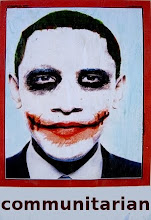
I found a picture of Etzioni with Obama.
It's looking more and more like Obama is another Israeli false flag operation.
There's a lot of people writing about Obama's civilian branch of the military, and speculation about how that would actually work is ongoing. Too bad most people won't make the connection between community economic development and a civilian military corps. The communitarians have been mapping people's skills and abilities for 50 years already. When the call comes to "serve" the common good, our callers already know what assets we have to contribute to the cause. They've also already identified the potential for problems.
Update on radio interviewsI've been invited back to Constance's radio show next Tuesday at 4pm Alaska time (8pm Eastern). Sorry about the mix-up on the showtime in my previous post, not many people realize Alaska is on its own time zone, an hour behind Pacific. Used to be 4 time zones in Alaska, and it was a real pain to try to call our government offices in Juneau when I lived in Fairbanks. I think that was also when I gave up bothering to vote in national elections because the national news would announce the winners before most Alaskans had gone to the polls. As for listening to it now and the 20 bucks a month fee, Pete commented that he has a recording that we can somehow download, and I'll work on that. Actually I've been asked more than once to create a better list of direct links to mp3s of all my interviews.
I'll also be a guest on Dr. Stanly Monteith's radio show on Thursday, January 8 at 3pm AK time.
http://www.radioliberty.com/Skinny Legs and All....
My veils arrived and they're so pretty. I made a video last night that Nordica won't let me put up. Heh. She said I can't read from 2020 with a veil on, period, end of discussion. I would've posted it if she hadn't called to say Merry Christmas and I told her about it. So then I started doing some research on Etzioni for a new ACL article and decided instead to make a video of him. I'm pretty excited that I figured out how to use Windows MovieMaker. Producing and writing video documentaries was my college journalism focus (not print), but that was way back when the cameras were so heavy I couldn't lift them myself, and editing, even though we taped in beta, was very complicated. I watched her make our gertee video and she's so fast at everything on the computer that I was sure I would always have to depend on her to make them for us (like website design). But I learn more watching than I realize.
Of course now I've spent hours scouring the internet for pictures and new quotes and I've got a lot of new info to sift through before I can write just a basic outline. Spent about eight hours studying the history of the Israeli Hagana, Palmach, Irgun and Stern Gang. Read through chronologies of events from the creation of the Hagana in 1940 to 1946, when some say he joined, through the terrorist activities of mid 1947 when he says he joined the underground. I found numerous conflicting, detailed historical accounts of the massacre at Dier Yassin and 2 other Palestinian massacres I never heard of before, plus I learned a lot more about all the Arab attacks on the Jewish settlers. I haven't even got to Etzioni's education under Buber starting in 1950.
Along the way I stumbled on Christopher Bollyn
http://www.bollyn.info/home/articles/middleeast/.
He asks what it means to the U.S. to have so many "former" Hagana soldiers and the sons and daughter of Irgun terrorists in such highly significant political places. He doesn't appear to have anything on Etzioni (or communitaianism), but his research on the Israeli connection to 9/11 opened my eyes to a whole other aspect to Etzioni's ties to the Mossad and Israeli intelligence services.
Etzioni has other ties too. He's written a lot about the "need" to build more moral communities and how people need to share more of their time and efforts:
""We" as a noun is used much more than "I" by the young sabras. But "always we" is not a slogan of their conformity for conformity's sake. It is taken from the hymn of the underground commando units (the Palmach). The entire line reads: "To orders--always we"; meaning, we are always ready to obey the orders of the nation. Riesman shows how the nouns of an ethos of production are replaced by the neutrality of abundance. The background in Israel is different. Therefore the norms around which conformity is crystalized are different. They are mainly: service to the collective goals of the nation, often at the expense of individual goals and individuality." AE, "The 'Sabra' in Israeli Literature," with Eva Etzioni, Jewish Frontier (October 1958), pp. 16-19., http://www.gwu.edu/~ccps/etzioni/E1.html
So then I went back and looked up the Maping and Mobilizing Community Assets program.
"John 'Jody' Kretzmann, co-director of the Asset Based Community Development (ABCD) Institute, was the keynote speaker for this year’s conference. ABCD is a research project of the Institute for Policy Research at Northwestern University working with community building leaders across North America as well as five other continents to conduct research, produce materials, and support community-based efforts to rediscover local capacities and to mobilize citizens’ resources to solve problems. Focusing on organizing the community based upon its strengths and assets is a guiding principle of the NORC supportive service paradigm and led to a fruitful presentation and discussion on common themes, practices, goals, and aspirations." http://www.ujc.org/page.aspx?id=93158
I didn't realize Michele Obama worked for them too.
"And then she started working for Public Allies, which was an organization really that had just recently started. And it was informed by the policies of a guy named Jody Kretzmann and John McKnight, who—I’ve been working with Jody for a long time, and he is an excellent community activist with a theoretical bent that focuses on assets. He goes to communities, and rather than look at the deficits of the community, he maps out the assets—him and John McKnight, their program that they started at Northwestern University. They map out the assets of the community and find ways to strengthen and embolden and reinforce those assets.
"And so, they hired Michelle. She became one of the first—I think the first executive director of Public Allies. And they do a magnificent job in hooking in promising college students into nonprofit organizations that are community-oriented and then—you know, and empowering work—attempting to empower parts of the community. And she really excelled there. A lot of people couldn’t understand why she would bring all those credentials, Harvard and Princeton, to such a lowly or community-oriented group, when she had such potential to make a lot of money in the corporate structure. And she really performed well at Public Allies." http://www.democracynow.org/2008/8/26/michelle_obama_delivers_keynote_address_on
The Obama Victory, Asset-Based Development and the Re-Politicization of Community Organizing, By Susan B. Hyatt
"Abstract: In this commentary, I argue that Obama’s victory in the recent Democratic primary was largely a consequence of his early experiences as an Alinsky-style community organizer in Chicago. I compare the nature of the broad-based organizing that Obama was trained in to a newer model of “community building” called Asset-Based Community Development (ABCD). ABCD promotes the belief that communities suffering the effects of economic restructuring, such as abandoned housing, crime, and deindustrialization among others, can “heal themselves” by looking within for resources—or “assets”—rather than by making demands on the state, a stance its proponents stigmatize as evidence of a “client” mentality. I argue that however chimerical its promises of redemption are, ABCD illustrates an important shift in
contemporary understandings of citizenship, away from the possibilities for collective action that characterize Alinsky-style organizing and toward a view that is both radically neoliberal and potentially totalitarian in its homogenizing notions of its two key concepts—“community” and “assets.” I suggest that the grassroots nature of the Obama campaign may have the potential to reanimate an interest in broad-based organizing toward the end of creating a more just distribution of resources.
http://209.85.173.132/search?q=cache:No4nojSDiiMJ:sananet.org/NAD/NADOct2008.pdf+jody+kretzmann+israel&hl=en&ct=clnk&cd=14&gl=us&client=firefox-a
Here's how it all goes global:
Asset Based Community Development - National Train the Trainer Courses
http://www.bankofideas.com.au/Newsletter/Newsletter_0806.htm
A unique opportunity exists for 30 people with an interest in asset based community development.
Led by Jody Kretzmann and two of his colleagues (Mary Nelson from Bethel Green Project) and Jim Diers, Department of Neighborhoods, Seattle), the courses will be run in:
* Sydney (30 November - 1 December, 2006)
* Melbourne (5 - 6 December, 2006)
For more information on the Melbourne event contact Peter Palmer - pp@bankofideas.com.au,and for the Sydney event Judi Geggie - Judi.Geggie@newcastle.edu.au.
So Jim Diers is a colleague of Kretzman's now, eh? He was the ONLY Seattle city employee who NEVER responded to my Public Disclosure Requests for documents. The Seattle Department of Neighborhoods was the lead organization gathering our personal data for the COMPASS program. Diers helped create the "new" city department after a short career as a "community activist" on Capitol Hill.
Who IS Jody Kretzman? I met him in 2000 when he gave an ABCD presentation to Seattle Neighborhood "leaders." He denied being a communitarian and denied any association with them. He lied. His co-founder of ABCD signed the Communitarian Platform. I wrote about my meeting him in our book, 2020, but not about how much he seemed like a military man. He's very tall and fit, and he was super polite and friendly when I was asking my questions in front of the group. He also tried to tell me the community maps were not "real" maps. He was less than friendly when I approached him afterwards and tried to buy a copy of his ABCD workbook. He actually said no, which was kind of a relief since I was really too poor to blow the cash, but then I realized he HAD to be lying when he said he had no copies with him. I mustered all the courage I could find in me and told him flat out, "I'm on to you guys." (Constance told me the other day she had experience with community asset building in Chicago in the 1960s, and from this vita on Jody I see he was there doing his thing way back when..uh huh.)
This is the html version of the file http://www.northwestern.edu/ipr/people/kretzmannvita.pdf.
Google automatically generates html versions of documents as we crawl the web.
Page 1
VITA
JOHN P. (JODY) KRETZMANN
Co-Director
Asset-Based Community Development Institute
Research Associate Professor
School of Education and Social Policy
Northwestern University
Evanston, IL 60208
Birth Date: December 6th, 1944
Family: Married to Ingrid Christiansen. Children: Katherine, Marcus
Education
B.A., English, Princeton University (Magna Cum Laude).
M.A., English, University of Virginia.
Ph.D., Sociology, Northwestern University.
Professional Employment
Co-Director, Asset-Based Community Development Institute, School of
Education and Social Policy, Northwestern University, 1996-present.
Research Associate Professor, School of Education and Social Policy,
Northwestern University, 2001-present.
Faculty Associate, Institute for Policy Research, Northwestern University,
2004-present
Senior Research Associate, Institute for Policy Research, Northwestern
University, 1990-2004.
Project Director, Neighborhood Innovations Network, Center for Urban
Affairs and Policy Research, Northwestern University, 1990-1996.
Research Staff, Center for Urban Affairs and Policy Research, Northwestern
University, 1984-1989.
Director, Urban Studies Program, Associated Colleges of the Midwest, 1984-
1989.
Co-founder and faculty member, Urban Studies Program, Associated
Colleges of the Midwest, 1969-1998.
Instructor in Media and Public Affairs, Christ College (Honors Program),
Valparaiso University, 1968-1969.
Community Organizer, Garfield Organization, Chicago, 1968.
Teaching Assistant, Department of English, University of Virginia, 1967.
Stringer, then reporter, Time and Life magazines, 1965-1966.
Chairman, The Daily Princetonian, 1965-66.
Page 2
2
Other Professional Activities
University Lectures and Speeches (partial list)
Michigan State University, lecture, 2006.
University of Illinois-Chicago, urban planning conference presentation, 2006.
Fordham University, lectures 2005-2006.
Allegheny College, Scholar in Residence, 2005.
DePaul University, Steans Center for Service Learning, lecturer and
consultant, 2005-Present.
University of Newcastle, Australia, keynote addresses at national
conferences, consultations, 2001, 2003, 2004.
Monmouth College, Fall Symposium, 2004.
Ohio Wesleyan University, Midwest conference on technology and the
community, keynote, 2004.
University of Chicago, Panel on the University and the Community, 2004.
University of Illinois-Chicago, School of Public Health, lectures, 2003, 2005.
University of Michigan, School of Social Work, lecture, 2002.
University of Wisconsin, Waisman Center, lecturer and consultant, 2002-
present.
Emory University, The Church and Community Development, keynote,
2002.
Loyola University, “The University and the Community,” keynote address,
2002.
Illinois Campus Compact, keynote address, 2001; Midwest Campus Compact,
keynote, 2003.
Cornell College, keynote address, annual symposium, 2000.
St. Francis Xavier University, Nova Scotia, lectures in community
development, 2000.
University of California, Riverside, keynote address, symposium on
community development, 2000.
University of Kentucky, Extension Conference, keynote address, 2000.
University of Pittsburgh, speeches, 1995, 2000.
Campus Compact, Brown University, speeches and consultation 1997-
present.
North Park University, Master of Arts in Community Development, annual
lecture, 1997-present.
Valparaiso University, numerous lectures, 1968-present.
Harvard University, John F. Kennedy School of Government, speaker and
member, Executive Seminar on Indigent Defense, 1999-2002..
New School for Social Research, Milano School of Social Science, speaker,
1999.
Colorado College, The Daniel Patrick O’Connor Lectures in Social Justice,
1999.
Concordia College, Annual Symposium, keynote address, 1999.
Michigan State University, University Outreach Partnerships, keynote
address, 1999.
Princeton University, lecture on community service, 1999, Alumni day
lecture, 2003.
Rutgers University, Boggs Center, University Affiliated Lecture on
Community Health, 1999.
University of Salford, England, Public Health lecture, 1999.
Page 3
3
Wright State Center for Child and Adolescent Violence, keynote address,
1999.
Washington University, speaker, Annual Symposium of George Warren
Brown School of Social Work, 1997.
Campus Outreach Opportunity League, keynote addresses, 1996-97.
Relating to State and Federal Government (partial list)
Corporation for National and Community Service, speeches, technical assistance,
provider.
U.S. Department of Housing and Urban Development, Office of University-
Community Partnerships, Annual Conference of Community Outreach
Partnership Centers, keynote, 2005.
New York Department of Health, keynotes, 2004, 2005.
Mass. Dept. of Health, keynotes and trainings, 2002-present.
North Carolina Association of Non-Profits, keynote, 2003.
Iowa Department of Public Health, lectures and consultations, 2002-present.
Minnesota Department of Public Health, lectures and consultations, 2001-
present.
Minnesota Department of Human Services, keynote, 2001.
U.S. Dept. of Agriculture, rural development lecture, 2001.
National Association of Community Action Agencies, 1997-present.
South Carolina Department of Health, Community Development, speaker,
consultant, 1996-present.
U.S. Department of Housing and Urban Development, speaker, consultant,
1993-present.
California Department of Health Services, speaker, 1999.
Illinois Council for the Prevention of Violence, 1998-99.
U.S. Department of Justice, Weed and Seed Program, speaker (4 occasions)
1996-99.
U.S. Department of Health and Human Services, speaker, 1997, 2001.
Relating to Local Government (partial list)
Chicago Public Library, co-publication, The Engaged Library. Presentations:
CPL Board of Directors, Urban Library Council’s national conference,
2005-2006.
Westchester County Summit on Vital Aging, keynote, 2006.
Indianapolis Police and Sheriff’s Departments, presentation, 2005.
Chicago Police Department, Community Policing Leadership Development Institute,
speeches and trainings, 2004-present.
Saginaw, MI. Celebration of Neighborhoods, keynote, 2005.
Northeastern Illinois Planning Commission (NIPC), speeches, trainings, 2004-
present.
Chicago Dept. of Public Health, speeches, consultations, 2003-present.
Batavia, IL, “Future of Western Suburbs,” speech, 2004.
Raleigh, NC, City Neighborhoods Conference, keynote, consultant, 2003,
2004.
Chicago, Union League Club, “Hope for Chicago’s Neighborhoods,” 2002.
Portland Dept. of Parks, keynote, 2002.
St. Louis Federal Reserve Bank, keynote, 2002.
Chattanooga Department of Neighborhoods, keynote address, 2000.
Seattle Department of Neighborhoods, speaker, consultant, 1998-2000.
Page 4
4
Portland Office of Neighborhood Involvement, speaker, consultant, 1997-
2002
Atlanta Neighborhood Development Partnerships, speaker, consultant, 1998-
99.
City of Dubuque, speeches and consultations, 1996-99.
Lake County Area Planning Council, keynote address, 1999.
Atlanta Project, speaker, consultant, 1997-98.
Chicago Board of Education, consultant, 1996-98.
Chicago Park District, consultant, speaker, 1994-2004.
Jacksonville, Ft. Lauderdale Departments of Neighborhood, keynote address,
1998.
Kansas City Department of Neighborhoods, speaker, consultant, 1995-98,
2002.
Peoria, IL, speeches and workshops, 1996-2003.
Florida League of Cities, keynote address, 1997.
National Association of Counties, speaker, 1997.
Active participant, numerous political campaigns, 1968-present.
Chair, Housing Policy Committee, Evans for Mayor, 1989.
Chair, Policy Review Committee, Washington for Mayor, 1986-87.
Chair/facilitator, Department of Economic Development/LISC conference on
Neighborhood Economic Development, 1985.
Initiator/consultant, Affirmative Neighborhood Information Program, City
of Chicago, 1983-1985.
Consultant/facilitator, Development Subcabinet Formative Retreat; and
Department of Planning Reorganization Retreat, Chicago of Chicago,
1983.
Contributor, Blueprint of Chicago Government and Toward a Prosperous,
Compassionate and Efficient Chicago, 1983.
Chair, Neighborhood Planning Subcommittee, Mayor Harold Washington
Transition Team, 1983.
Contributor, Washington Papers, 1983.
Relating to Neighborhoods (partial list)
City Year Chicago, Presentation, 2006.
Perspectives Charter School, presentations and consultation, 2005-present.
United Jewish Appeal, New York, speech and workshop, 2006.
Yonkers Elder Friendly Initiative, speeches and consultation, 2004-present.
Active member and consultant, numerous neighborhood organizations in
Chicago, 1968-present.
Jewish Council on the Elderly, Chicago, speaker-consultant, 2004, 2005.
North Carolina Neighborhood Conference, keynote, 2004.
Metropolitan Family Services, Chicago, speaker and trainer, 2002-present.
Leadership Evanston, keynote, 2003.
Chicago Area Project, speaker, consultant, 2002-present.
Imagine Chicago, speaker, 2002.
Indianapolis Neighborhood Resource Center, speaker, consultant, 1998-2003.
Chicago Alliance for Neighborhood Safety, speaker, 1998-99.
Neighborhoods USA, annual conference speaker, Portland, 1998.
Consultant/facilitator, Chicago Innovations Forums, Center for Urban
Affairs and Policy Research, Northwestern University, 1988-1996.
Page 5
5
Consultant, Local Development Issues Working Group, Community
Workshop on Economic Development, 1988-1989.
Evaluator, Neighborhood Vouchers Program, National Center for
Neighborhood Enterprises, Washington, D.C., 1985-87.
Co-designer/developer, Affirmative Neighborhood Information Program,
1983-85.
Co-founder and Steering Committee, Community Workshop on Economic
Development, 1979-1983.
Leadership Conference, Organization of the North East, 1974-1980.
Relating to Philanthropy (partial list)
Battle Creek Community Foundation, community congress keynote, 2005.
Annie E. Casey Foundation, consultation on intergenerational funding, 2006.
Evanston Community Foundation, conference on funding sustainable communities,
presentation, 2006.
Neighborhood Small Grants Network, national audio-conference speaker, 2005.
Kellogg Foundation, speaker, consultant, 2004-present.
Northwest Council on Foundations, keynote, 2004.
Grantmakers in Aging, keynote, 2004.
Southeastern Council on Foundations, keynote, 2004.
Indiana Association of Grantmakers, keynote, 2004.
Northwest Area Foundation, speeches and trainings, 2003-2004.
W. T. Grant Foundation, consultant, 2002.
Michigan Funders Network, keynote, 2002.
Synergos, (Ford Fndn.), speeches, consultations, 2002-present, including
Mexico border initiative.
United Ways of Rochester, Chicago, San Antonio, Mesa, Evansville,
Indianapolis, Greenville (SC), Philadelphia, etc.—speeches and
consultations, 1991-present.
Duke Endowment, North Carolina, speech and consultation, 2000.
Blandin Foundation, Minnesota, consultations, 1992-2002.
Council on Foundations, 4 speeches and workshops, 1995-present.
Kinship Fund, Chicago, consultations, 1996-present.
Lila Wallace-Readers Digest Fund, speaker, consultant on parks and libraries
initiatives, 1997-2001.
Grantmakers in Health, speech, consultations, 1997-99.
New Mexico Community Foundation, speeches and technical assistance,
1994-99.
California Endowment, speech and consultations, 1997-98.
Maine Community Foundation, speaker, 1998.
St. Louis Metropolitan Association for Philanthropy, speaker, 1998.
Points of Light Foundation, National Community Service Conference, 1997.
Southeastern Council on Foundations, keynote address, 1997.
Community Foundations: speeches and consultations, including East
Tennessee, Jacksonville, Greater Memphis, Winston-Salem, Montana,
Denver, Tucson, Central New York, 1992-present.
Los Angeles Urban Funders, speaker, workshops, 1996.
United Way of America, speeches, consultations, 1993-2003.
Relating to Professional Organizations (partial list)
Coalition for Community Schools, presentations and training, 2004, 2005.
Page 6
6
Minnesota Healthy Aging Conference, keynote, 2003.
Goodwill Industries, keynote, 2003.
American Society on Aging, keynote, speeches, consultations, 2002-present.
National Community Building Network, speaker, 2002.
YMCA, speaker and consultant, national and local gatherings, 2002-2004.
Rural Development Association, keynote, 2002.
American Academy of Pediatrics, presentations and consulting, 2002-2004.
City Cares, keynote, 2002.
Public Allies, keynotes and trainings, 1993-present.
Kaboom, keynotes yearly, 2001-present.
South Carolina Association of Non-Profits, keynote, 2001.
Voices for Illinois Children, keynotes, 2001, 2002, consultant, 2001- 2004.
Habitat for Humanity, frequent speaker,1999-present.
Search Institute, speaker, consultant, 2001-present.
American Library Association, speaker, 2000, 2002.
Executive Service Corps, Chicago, keynote address, 2000.
Health Care Forum, speaker, consultant, trainer, 1995-2003.
Urban Libraries Council, speaker, consultant, 1998-present.
Vera Institute of Justice, New York, speaker, consultant, 1998-2001.
Cross City Campaign for Urban School Reform, speaker, consultant, 1997-99.
American Academy of Pediatrics, consultations, 1998-99, 2003-04.
Daughters of Charity Hospitals, speaker, consultant, 1995-99.
Kentucky Community Development Society, speaker, 1999.
Indiana Public Health Association, keynote address, 1998.
Southern Rural Development Association, speeches and workshop leader,
1998.
Urban Parks Institute, speaker, 1997-98.
American Association of Retired Persons, speech, 1997.
American Public Health Association, speaker, 1997.
Public Health Institute, California, speech, 1997.
Relating to International Work (partial list)
Australia Federal Department of Family and Community Services,
presentation, 2006.
The Smith Family, Australian Philanthropy, day-long workshop, 2006.
United Way International Global Assembly, keynote, 2006.
England, Scarman Trust training, 2004.
Germany, bi-national consultation on immigration, 2003-2004.
Australia, speeches, trainings in four visits, across the continent, 2001-present.
Canada, Coady Institute, Saint Francis Xavier University, speaker, consultant,
2000-present.
Canada, Department of Environment, speeches and training, 1999-2000.
Canada—numerous speeches sponsored by government, philanthropies,
professional groups and community development groups, 1988-present.
Egypt, United Nations Development Program, week-long training in Cairo,
1999.
England, British Public Health System, lectures, 1998-99.
South Africa, Community Higher Education Partnership, 10 day visit, lectures
and training, 1999.
Page 7
7
Caribbean and Latin America, Peace Corps directors, speeches and training,
1997-98.
Relating to Religious Organizations (partial list)
Church World Services, National Conference on Disaster Relief, Princeton
Seminary, keynote, 2006.
Lutheran Services in America, annual conference, keynote, 2004.
Pendle House, Philadelphia, Peacemaking consultation, speaker, 2005.
Partners for Sacred Places, presentations and consultations, 2000- Present.
Colorado Summit on Hunger, keynote and workshops, 2000.
Diocese of Cleveland, speaker, 1999-2000.
Evangelical Lutheran Church in America, numerous speeches, ongoing
consultation, 1987-present.
Habitat for Humanity conventions, speaker, 1998-present.
Methodist Communities of Shalom, speaker, consultant, 1997-present.
Partners for Sacred Places, speaker, consultant, 1998-present.
Salvation Army, speaker (5 occasions) 1997-present.
Call to Renewal, speaker, 1999.
McCormick Seminary, visiting professor, African American Leadership
Program, 2002, 2003.
Trinity Seminary, Columbus, Ohio, keynote address and workshop, 1998.
Visiting Professor, Lutheran School of Theology at Chicago, 1988-1996.
National Co-chair, Justice Network in the Lutheran Church, 1988-1995.
Board of Directors, Clergy and Laity Concerned, 1978-1996.
Program Director, Holden Village Retreat Center, Washington State, 1986,
1988. Founder, Rainbow on the Mountaintop (Multicultural Celebration),
1987-1990.
Among other boards and consultancies: Conference on Inner City Ministries,
Lutheran Human Relations Association, Cleveland Metro Ministries, City
Lutherans in Action, Independent Lutheran Press.
Northwestern University Activities (partial list)
Service Learning Certificate, speaker, bus tour leader, 2003-present.
Oasis, speaker, 2005-2006.
Northwestern University Alternate Spring Break, speaker, 1999-present.
Northwestern University New Student Orientation, speaker, 1999, 2000.
Northwestern University Undergraduate Leadership Program, speaker and
consultant, 1994-present.
Northwestern University Alumni College, speaker, panelist, 1998.
Northwestern University Freshman Urban Program, opening speaker, 2000-
present.
Northwestern University DERU advance, 2002-present.
Northwestern University Civic Education Project, speaker, 2001-present.
Relating to Civic Involvement—Board Memberships (partial list)
Urban Libraries Council, Exec. Board, 2004-present.
Princeton Project ’55, Board, 2002-present.
Delta Institute (environment/economic development/non-profit), 1998-
present (Chair).
North Park University, Master of Arts in Community Development
Program, 1997-present.
Page 8
8
Public Allies, Chicago (also speaker, trainer), 1995-present.
Seminary Consortium for Urban Pastoral Education, 1965-present.
Wieboldt Foundation, Board of Directors, 1987-1997.
Page 9
9
Academic and Other Awards
Entrepreneurial American Leadership Award, Partners for Livable
Communities, Washington, D.C., 2006.
Outstanding Professor Award, School of Education and Social Policy,
Northwestern University, 2005.
Community of the Cross Award, Lutheran School of Theology, Chicago,
1998.
Distinguished Community Service Award, Princeton Club of Chicago, 1995.
National Merit Scholar
Newspaper Fund Scholar
University of Virginia Fellowship
Northwestern University Fellowship
Center for Urban Affairs and Policy Research Fellowship, Northwestern
University.
Subjects Taught
City politics, city economics, community development, social movements,
racism, dynamics of neighborhood change, mass media, ethics and politics,
the church and public life, public policy and human services, schooling in
communities.
Video
Kretzmann, John P., and McKnight, John L., Mobilizing Community Assets, Civic
Television Network, six-part series, 1995.
Books
Kretzmann, John P. and McKnight, John L. Building Communities from the
Inside Out: A Path Toward Finding and Mobilizing a Community’s
Assets. Evanston, IL: Institute for Policy Research, 1994.
Workbooks
Kretzmann, John P., editor, The Engaged Library, Chicago Public Library, Urban
Libraries Council, Asset-Based Community Development Institute, 2005.
Kretzmann, John P., McKnight, John L., Discovering Community Power: A Guide to
Mobilizing Local Assets and Your Organization’s Capacity. Evanston, IL: Asset-
Based Community Development Institute in cooperation with the Kellogg
Foundation, 2005.
Kretzmann, John P., McKnight, John L., and Green, Mike, Hidden Treasures: Building
Community Connections, Evanston, IL: Asset-Based Community Development
Institute, 2005.
Page 10
10
Kretzmann, John P., McKnight, John L., and Sheehan, Geralyn; Building the Mercado
Central: Asset-Based Development and Community Entrepeneurship. Evanston, IL:
Institute for Policy Research, 2004.
Kretzmann, John P., McKnight, John L., and Rans, Susan, Asset-Based Strategies for
Faith Communities, Evanston, IL: Institute for Policy Research, 2003.
Kretzmann, John P.; McKnight, John L., eds, Deborah Puntenney, A Guide to Building
Sustainable Organizations from the Inside Out, Evanston, IL: Institute for Policy
Research and Chicago Foundation for Women, 2002.
Kretzmann, John P.; McKnight, John L; and Snow, Luther. The Organization of Hope:
A Workbook for Rural Asset-Based Community Development. Evanston, IL:
Institute For Policy Research, 2001.
Kretzmann, John P.; McKnight, John L.; and Snow, Luther. Community
Transformation: Turning Threats into Opportunities. Evanston, IL: Institute for
Policy Research, 2002.
Kretzmann, John P.; McKnight, John L.; and Turner, Nicol. A Guide to
Mapping and Mobilizing the Associations in Local Neighborhoods.
Evanston, IL: Institute for Policy Research, 1999.
Kretzmann, John P.; McKnight, John L.; and Puntenney, Deborah. A Guide
to Creating a Neighborhood Exchange: Building Communities by
Connecting Local Skills and Knowledge. Evanston, IL: Institute for Policy
Research, 1998.
Kretzmann, John P.; McKnight, John L.; and Sheehan, Geralyn. A Guide to
Capacity Inventories: Mobilizing the Community Skills of Local
Residents. Evanston, IL: Institute for Policy Research, 1997.
Kretzmann, John P.; McKnight, John L.; and Puntenney, Deborah. A Guide
to Mapping and Mobilizing the Economic Capacities of Local Residents.
Evanston, IL: Institute for Policy Research, 1996.
Kretzmann, John P.; McKnight, John L.; and Puntenney, Deborah. A Guide
to Mapping Consumer Expenditures and Mobilizing Consumer
Expenditure Capacities. Evanston, IL: Institute for Policy Research, 1996.
Kretzmann, John P.; McKnight, John L.; and Puntenney, Deborah. A Guide
to Mapping Local Business Assets and Mobilizing Local Business
Capacities. Evanston, IL: Institute for Policy Research, 1996.
Kretzmann, John P.; McKnight, John L.; and Puntenney, Deborah. (Eds.)
Newspapers and Neighborhoods: Strategies for Achieving Responsible
Coverage of Local Communities. Evanston, IL: Institute for Policy
Research, 1999.
Kretzmann, John P. and McKnight, John L. (Eds.), with Puntenney, Deborah,
and Moore, Henry. Leading by Stepping Back: A Guide for City Officials
Page 11
11
on Building Neighborhood Capacity. Evanston, IL: Institute for Policy
Research, 1999.
Kretzmann, John P. and McKnight, John L. (Eds.), with Puntenney, Deborah,
and Moore, Henry. City-Sponsored Community Building: Savannah’s
Grants for Blocks Story. Evanston, IL: Institute for Policy Research, 1998.
Kretzmann, John P. and McKnight, John L. (Eds.), with Thomas Dewar. A
Guide to Evaluating Asset-Based Community Development: Lessons,
Challenges, and Opportunities. Evanston, IL: Institute for Policy
Research, 1997.
Kretzmann, John P. and McKnight, John L. Mapping Community Capacity.
Evanston, IL: Center for Urban Affairs and Policy Research, 1990.
(Booklet)
Articles and Chapters Published
Kretzmann, John P. “Congregations and Communities Working Together.”
In Edward L. Queen II (Ed.) The Management and Organization of
Religious Human and Social Services. San Francisco: Jossey-Bass, Inc.,
2000.
Kretzmann, John P. “Opening up a Closed City.” In Harold Washington and
the Neighborhoods. Rutgers University Press, 1991.
Kretzmann, John P. “Co-Producing Health: Professionals and Communities
Build on Assets.” Health Forum Journal, January/February, 2000: 42.
Kretzmann, John P. “The Campus and the Community: Sharing Power for a
Democratic Future.” Third Annual Continuums of Service Conference
Proceedings, Campus Compact, July, 2000.
Kretzmann, John P. “Habitat for Humanity and Asset-Based Community
Development: Powerful Partners for Vital Communities.” Habitat for
Humanity Affiliate Update, October, 1999.
Kretzmann, John P. “Building Communities and Economies from the Inside
Out.” Community Action Digest. Spring, 1999.
Kretzmann, John P. and Green, Michael B. Building the Bridge from Client to
Citizen: A Community Toolbox for Welfare Reform. Evanston: Institute
for Policy Research, 1998. (Reprinted from Shelterforce,
November/December, 1997. 10-14.) (Booklet)
Kretzmann, John P. and Schmitz, Paul H. “It Takes a Child to Raise a Whole
Village.” Resiliency in Action, March/April, 1999. (Reprinted from
Wingspread Journal, 1994-95, The Johnson Foundation.)
Page 12
12
Kretzmann, John P. “Study the Successes—Don’t focus on Failure”
Philadelphia Inquirer, Sunday, April 20, 1997. E8. (Special Edition for
President’s Summit on Volunteerism)
Kretzmann, John P. “Rediscovering Community Through Parks,” Parks as
Community Places, Urban Parks Institute, August, 1997.
Kretzmann, John P. “What Every Parish Should Know About Itself.” Our
Family, September 1997. 37-39.
Kretzmann, John P. Vital Schools, Vibrant Communities, Cross City
Campaign for Urban School Reform, September, 1997. (Booklet)
Kretzmann, John P. and Green, Michael B. “Community Tool Box for
Welfare Reform: Building the Bridge from Client to Citizen,”
Shelterforce, November/December, 1997. 10-14.
Kretzmann, John P. “Community Includes Youth: 10 Commandments for
Involving Young People in Our Communities,” Wingspread Journal,
Autumn, 1995. 11.
Kretzmann, John P. “Building Communities from the Inside Out,”
Shelterforce, September/October, 1995. 8-11.
Kretzmann, John P. and McKnight, John L. “Building Communities from the
Inside Out: A Path Toward Finding and Mobilizing a Community’s
Assets—An Overview,” Community Capacity Building from the Inside
Out, United Way of America, June, 1995.
Kretzmann, John P. and Schmitz, Paul H. “It Takes a Child to Raise a Whole
Village,” Wingspread Journal, Annual Report, 1994-95. 8-11.
Kretzmann, John P. and McKnight, John L. “Mapping Community
Capacity,” Community News, (Michigan State University) Fall, 1993. 1-4.
Kretzmann, John P. “Community-Based Development and Local Schools: A
Promising Partnership,” Evanston: Institute for Policy Research Working
Paper, 1992.
Kretzmann, John P. School Participation in Local Community Economic
Development: Ideas for Getting Started. Evanston, IL: Center for Urban
Affairs and Policy Research, 1990. (Booklet)
Kretzmann, John P. “Popular Movements in Mexico City,” Christian
Century, 1990.
Kretzmann, John P. “Dawn of the Age of Fairness: Washington’s
Development Policies,” Chicago Enterprise, March 1987.
Page 13
13
Kretzmann, John P. “The Illinois Governor’s Race,” Chicago Enterprise,
November, 1986.
Kretzmann, John P. “Power and Information in the City,” Center for Urban
Affairs and Policy Research, 1985.
Kretzmann, John P. A Primer for a School’s Participation in the Development
of its Local Community. Evanston, IL: Institute for Policy Research, 1988.
(Booklet)
Kretzmann, John P. and McKnight, John L.
“Community Organizing in the 80s,” Social Policy, Winter, 1984.
Editorial
Editorial Advisory Board, Community Action Digest, National Association of
Community Action Agencies, 1999-2003.
Updated 8/06
Who is John McNight? (besides being the man who signed and edorsed Obama's Harvard Law School application)
http://www.northwestern.edu/ipr/people/mcknight.html