There's a very good reason I've never identified with the Conservative Right. Many Conservatives support the ACL because we publish facts they use. They simply respect our quality of work. Many conservatives are put off because I don't identify myself as a Conservative or a Christian. They ask me to. I won't. If I did, I'd have a lot more readers, supporters, and a lot more promotions. If I were anything, even a Lesbian Democrat, I'd be a lot better off than being what I am. In order to appeal to my countrymen I must wear a label. But I don't identify myself as anything but anticommunitarian, and the American people have yet to become aware of what that means.
Once I identified the thesis and the antithesis leading to the communitarian synthesis, I became aware of the dialectical roles each "side" plays in promoting the communitarian synthesis. After that I could never participate in any "side" that helps the communitarians. Then we showed with our antithesis how the evidence verifies the transformation of all societies into one big blob. Okay, so I never described it as a "blob," but maybe I should have! People know what that word means.
Today the communitarian synthesis (or blob) is manifesting in the Tea Party. I warned Americans this was going to happen in my Open Letter to Local Tea Party members in 2010. http://nikiraapana.blogspot.com/2010/10/open-letter-to-all-members-of-local-tea.html
Either I have special powers of divination, God told me what to write, or I'm a damn good journalist. Whatever I am, I am the ONLY writer in the world who saw this coming and warned the public about it years before it happened. Now there's a "Tea Party Communitarian"! Oh yeah.
Tea Party Communitarian Can Sen. Mike Lee get libertarian populists to put family first?
By JONATHAN COPPAGE • November 19, 2013
Article re-posted in its entirety from The American Conservative website http://www.theamericanconservative.com/articles/tea-party-communitarian/:
Mike Lee is an unlikely candidate for conservatism’s most promising policy mind. A Tea Party firebrand since he swept into office in 2010, Lee was the driving force behind efforts to defund Obamacare that led to a 16-day government shutdown this October. Yet the past year has also seen him reveal another side to his populist conservatism: a communitarian agenda for policy reform.
At the American Enterprise Institute in September, Lee set out a tax-reform proposal centered around a per child tax credit that would apply to income and payroll taxes alike. At the unveiling, Lee said: “Now, if you are like me—a conservative with a libertarian streak—you might at first raise an eyebrow at all this. My plan, you might say, may share some features of traditional conservative tax reform but it’s no flat tax. It’s no consumption tax,” two policies long favored by conservative for their economic efficiency or ostensible fairness.
“That’s right,” he continued. “It’s better.”
With the slightest hint of braggadocio that only a humble Utahn can muster, Lee broke with the economic individualism of the conservative establishment to prioritize instead the family, “the first and foremost institution of civil society.” There was a sound economic basis for this, to be sure. Lee drew attention to what he called the “Parent Tax Penalty” whereby parents doubly contribute to entitlement programs through their taxes and the expenses they incur raising future taxpayers. And he insisted, “Here, I am not speaking about the family as a moral or cultural institution, strictly as a social and economic one.” But that in itself is significant: the family, not just the individual, is what economics must be about.
“Conservatives sometimes get criticized for putting too much emphasis on the family in policy debates,” he acknowledged. But “the real problem may be that we don’t think about the family enough. For family is not just one of the major institutions through which people pursue happiness. Is the one upon which all the others depend.”
At the Heritage Foundation in April, Lee delivered a communitarian manifesto of sorts entitled “What Conservatives Are For.” He emphasized “that the true and proper end of political subsidiarity is social solidarity” and explained that his “vision of American freedom is of two separate but mutually reinforcing institutions: a free enterprise economy and a voluntary civil society.”
Lee’s proposals focus on relieving burdens on the institutions that strengthen society in their everyday practice. This outlook goes straight back to his Utah origins. “We’ve always been a state that has had strong institutions of civil society, very strong neighborhoods, very connected neighborhoods where people know each other,” the senator tells me. “Sometimes people are quick to assume that that just refers to people who are members of my church, the Church of Jesus Christ of Latter-Day Saints, but it’s not just that. There’s a very strong neighborhood dynamic in Utah that perhaps traces back to the way we were settled,” he explains.
“People had traveled great distances, sometimes thousands of miles to get there to what was initially a fairly desolate desert. The Salt Lake Valley was said to only have one or two trees when the first Mormon Pioneers arrived in 1847, and it required people to work together a lot to build these communities, to make the desert blossom like a rose. And that has become part of our culture, and it has thrived.”
{Niki ads this link here: Mormon Communitarianism- Distinct by Eschatology
Communitarian concern for the social fabric and libertarian resistance to big-government interventions fit together naturally for the Utah senator. “Lee has been eager to show that social conservatism and concern for the family doesn’t speak a different language than his kind of constitutionalism and limited government-ism,” says Yuval Levin, editor of the policy quarterly National Affairs. Levin is encouraged by the direction he sees leaders like Lee taking.
“I think there’s been a tendency for a decade or more in conservatism to move away from communitarian talk to a much more individualist talk, and it’s very much in need of counterforce,” he says. “Conservatism needs to be a counterweight to radical individualism, not an enabler of it, and to me to see that being expressed again is really crucial.”
At AEI, Lee opened his proposal by speaking of “a new and unnatural stagnancy” that has trapped the poor and worn down the middle class. There are the beginnings here of a different way of talking about the economy, in contrast to the GOP’s old prosperity gospel for the upwardly mobile. Republicans a year ago proved all too ready to fan the flames of upper-class resentment with talk of the 47 percent of Americans who pay no federal income tax. Lee rebukes that mentality, pointing out at AEI that “people who pay no income tax do pay federal taxes—payroll taxes, gas taxes, and various others,” and squarely declaring, “Working families are not free riders.” 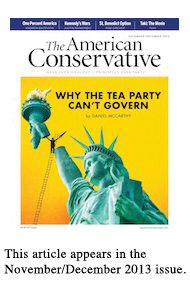
Lee rails upward instead, against the cronyism that big government and big business together have cultivated at the taxpayer’s expense. “At the top of our society, we find a political and economic elite that—having reached the highest rungs—has pulled up the ladder behind itself, denying others the chance even to climb,” he warned at AEI. At Heritage, he went so far as to say, “The first step in a true conservative reform agenda must be to end this kind of preferential policymaking. Beyond simply being the right thing to do, it is a prerequisite for earning the moral authority and political credibility to do anything else.” How, he asked, could working families take seriously a conservatism that props up and subsidizes big banks and corporate agricultural interests?
For a GOP long seen as the party of entrenched financial interests, populist credibility must be won back, and a deregulation agenda alone won’t cut it. This is where Lee’s rugged communitarianism is especially vital to his cause. In his Heritage speech, he described the conservative vision as “not an Ayn Rand novel. It’s a Norman Rockwell painting, or a Frank Capra movie: a society of ‘plain, ordinary kindness, and a little looking out for the other fellow, too’. ”
He continued,
In the last few years, we conservatives seem to have abandoned words like ‘together,’ ‘compassion,’ and ‘community’ as if their only possible meanings were as a secret code for statism. This is a mistake. Collective action doesn’t only—or even usually—mean government action. Conservatives cannot surrender the idea of community to the left, when it is the vitality of our communities upon which our entire philosophy depends.
Lee’s understanding of civil society redirects what often seems like a pure populist backlash—a mere reaction—to finding constructive ways in which limited-government constitutionalists can act on James Madison’s notion that government is for “the happiness of the people” and Abraham Lincoln’s idea that it ought “to lift artificial weights from all shoulders, to clear the paths of laudable pursuit for all.”
But can Lee sell his communitarian message to his fellow constitutionalists? Levin is hopeful: “He has a shot because to a certain extent he’s filling a vacuum, and that means he really has an opportunity to shape the arena the way he wants to.”
As Lee himself said at AEI: “For a political party too often seen as out of touch, aligned with the rich, indifferent to the less fortunate, and uninterested in solving the problems of working families, Republicans could not ask for a more worthy cause around which to build a new conservative reform agenda.”
Jonathan Coppage is associate editor of The American Conservative.
This article was reposted in numerous places around the USA:
http://www.metrowestdailynews.com/opinion/x915445929/Gerson-The-communitarian-tea-partier?rssfeed=true
http://www.capjournal.com/opinions/columnist/the-communitarian-mike-lee/article_76f2773c-51a7-11e3-b8da-0019bb2963f4.html
http://townhall.com/tipsheet/conncarroll/2013/11/19/how-mike-lee-is-changing-the-republican-party-n1749558
http://www.deseretnews.com/article/865590873/Utah-Sen-Mike-Lee-emerges-as-a-communitarian.html
This article was reposted in numerous places around the USA:
http://www.metrowestdailynews.com/opinion/x915445929/Gerson-The-communitarian-tea-partier?rssfeed=true
http://www.capjournal.com/opinions/columnist/the-communitarian-mike-lee/article_76f2773c-51a7-11e3-b8da-0019bb2963f4.html
http://townhall.com/tipsheet/conncarroll/2013/11/19/how-mike-lee-is-changing-the-republican-party-n1749558
http://www.deseretnews.com/article/865590873/Utah-Sen-Mike-Lee-emerges-as-a-communitarian.html