Showing posts with label irish referendum. Show all posts
Showing posts with label irish referendum. Show all posts
Saturday, October 3, 2009

Friday, October 2, 2009
Europe waits for Irish Lisbon treaty result - Americans could care less
Here's a very good overview of the Irish take on the failed Lisbon Treaty:
Europe waits for Irish Lisbon treaty result
http://www.telegraph.co.uk/news/worldnews/europe/ireland/6255516/Europe-waits-for-Irish-Lisbon-treaty-result.html
Europe is holding its breath after the Irish went to the polls on Friday for a rerun referendum on the Lisbon Treaty amid "scaremongering" warnings of economic catastrophe should they vote No for a second time.
By Bruno Waterfield in Tallaght
Published: 5:02PM BST 02 Oct 2009
Ireland is the only country, out of the EU's 27, to hold a popular vote on the Lisbon Treaty, a text that is largely the same as Constitution rejected by French and Dutch voters four years ago. {ed note: the French and Dutch rejected the contract with "critical eyes" on the EU's supremacy of communitarian law clause, so far there's been no indication the Irish are aware of the actual legal system in the EU}
Irish voters first rejected the EU Treaty 18 months ago by a margin of 53.4 per cent to 46.6 per cent but they have been asked to think again following pressure from other 26 European countries, which all denied popular votes to their citizens.
Most opinion polling now gives the "Yes" camp a 55 to 60 per cent lead with fears that a renewed "No" will plunge Ireland's economy into a deeper crisis regarded as the main factor in the shift.
Brian Cowen, the Irish prime minister, with the support of Irish and multinational big business has linked the vote to Ireland's economic future after the country was hit harder than most other EU member states by the global financial crisis.
"A Yes vote marks an essential step for economic recovery. Only with a Yes will we ensure investor confidence in Ireland," he said, at his final press conference before polls opened.
No campaigners have dismissed Mr Cowen's claims that Yes vote will create new jobs as "scaremongering and lies".
No campaign posters and billboards have displayed pictures of Mr Cowen, the most unpopular premier in the history of the Irish Republic, alongside the slogan, "the only job Lisbon saves is his".
As polling stations opened on Friday morning, hundreds of taxi drivers took to the streets, many bearing "No to Lisbon" placards, to protest at the government's handling of the economy.
Liam Murphy, a Dublin cab driver, said: "We have been fed lies and blackmailed with scaremongering about the economy. The treaty does not mention jobs. It is scaremongering by a government that just wants to hang on to its own jobs."
Soaring unemployment and the economic crisis has hit Tallaght's working class estates, south west of Dublin, harder than most of Ireland but its people have remained defiant.
At the St Kevin's Boys School polling station in Tallaght's Kilnamanagh district, Shane O'Leary insisted that he would still vote No.
"People have been scared. But the recession does not change this treaty or our rejection of it last time," he said.
Kathleen Cummins, another "No" voter, said: "I think we are being bullied and treated like children."
But Charles Dussey admitted that he had changed his vote because of fears that the EU would pull the plug on funding if there was a second referendum rejection.
"The country is bankrupt. The EU is signing the cheques. We cannot bite the hand that feeds us at the moment," he said.
If the Lisbon Treaty is rejected by the Irish a second time then the EU would be plunged into a deep institutional crisis.
"We are hearing that the vote is very close and unpredictable," said an EU official last night.
All 26 other EU countries have ratified the treaty by parliamentary procedures but the Polish and Czech presidents have delayed a final signing until the Irish vote.
The results will be announced on Saturday afternoon.
Propaganda for the Third Way - it's back!
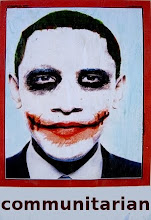
From Peter Myer's elist an "American" tells us how backwards and insane Americans are to not embrace their spiritual evolution into the Communitarian Third Way. Isn't it fitting that Tony Blair, the UK's Third Way candidate from the 90s is slated to be the First President of the EU as soon as the Irish get over themselves and vote YES on the Lisbon Treaty? And what great news to hear the Czech High Court's decision to hear the case against the EU. President Vaclav Klaus is one of the few leaders I've found who identify the EU as "bad" communitarian. As the Wall Street Journal writes, "Klaus argues that the Treaty infringes on the sovereignty of E.U. member states."
(6) America's Failed Model - not looking so Super anymore
From: IHR News <news@ihr.org> Date: 01.10.2009 04:40 PM
Steven Hill -- The Guardian (Britain)
http://www.guardian.co.uk/commentisfree/cifamerica/2009/ sep/15/europe-us-healthcare- economy
America's failed model for the world
Europeans keep asking me, has America lost its mind? From healthcare to its economy, the US is looking merely average
o Steven Hill
o guardian.co.uk, Wednesday 16 September 2009 16.00 BST
Europeans are shaking their heads over their American friends again. Whether talking to people in the street, in the cafés or to journalists or political leaders, everyone here asks me the same question: Has America lost its mind? Town halls filled with angry citizens, shouting at their elected leaders, some of them armed with guns and threatening signs? Besides the media spectacle of these neo-1776 revolutionaries, what is doubly perplexing to Europeans is the focus of the protests: healthcare.
What's strange to a European is that everyone here already has healthcare. The place that Donald Rumsdfeld once sneeringly called "old Europe" long ago solved this dilemma, producing quality healthcare for a fraction of the price that Americans pay. Many Europeans are astonished when they find out that 47 million Americans – larger than the populations of most European nations – don't have any healthcare at all except a hospital emergency room.
Contrary to stereotype, most of Europe doesn't use single payer, with France, Germany and others having evolved a "third way" that combines individual choice with private, nonprofit insurance companies and Medicare-like cost controls. Even countries like Croatia, Hungary and Slovenia, with per capita incomes only a fraction of that in the United States, have healthcare for all their people. Europeans simply don't understand how a wealthy United States could remain the last advanced nation that does not have universal healthcare.
Lounging one evening in one of Budapest's elegant thermal baths larger than an Olympic swimming pool, with Europeans of all ages and nationalities soaking their limbs in relaxed leisure, I was treated to a dose of the common wisdom that is taking hold here. Introducing myself as an American evinced a swift reaction from one sweating sauna companion:
"I don't understand you Americans. You blow billions on a useless war in Afghanistan and Iraq, and billions more to bail out banks that nearly bankrupted the world economy, but you don't ensure healthcare for your own people. Even Obama can't make a difference. It's as if your democracy doesn't work anymore."
He was Austrian but spoke in a near-perfect English that was as good grammatically as that spoken by some of my relatives.
And his reaction was typical. As Europeans watch the United States flailing about over something as basic as healthcare, they are reminded once again of the impotent US response following Hurricane Katrina. TV images of stranded, poor, black people in New Orleans have been melded to those of this new healthcare insurgency with pitch forks, leaving an indelible impression. The last remaining superpower is not looking so super anymore, whether in Iraq, Afghanistan, healthcare, the economy – not anywhere.
The global economic collapse, largely blamed on out-of-control Wall Street capitalism, is stinging here as well, though in most regions Europe has not suffered as much as America has. In my informal polling of small business and shop owners, they said the downtown had hurt, but only a little bit. Since the crisis, Europe has employed clever strategies – some of them since copied by the Obama administration, such as the popular "cash for clunkers" auto rebate programme – that have prevented it from suffering the doubling of unemployment that the US is enduring.
Indeed, Europe, once looked down upon by American pundits as the land of double-digit unemployment, currently has lower unemployment than the United States. Contrary to Europe's reputation as having a sick, sclerotic economy, its per capita economic growth rate actually was slightly higher than America's in the 10 years leading up to the economic crisis.
Still, a number of people fear that the worst is yet to come. And so Europeans appear both angry and perplexed by America's deregulated capitalism run amok, which has further served to undermine the American brand. As one Slovenian acquaintance, a representative of a consortium of small businesses said to me: "The US used to lecture us in Europe about just about everything, but what does America have to teach now? Maybe America should learn something from Europe."
Indeed, with Germany and France becoming the first major western economies to emerge from recession into positive growth, perhaps the US should learn something from our transatlantic cousins. But what might we learn?
Here's a clue, say some Europeans. German chancellor Angela Merkel once was asked by then-British prime minister Tony Blair what the secret was of her country's economic success, which includes being the world's largest exporter nation and running substantial trade surpluses. She famously replied: "Mr Blair, we still make things."
Werner Abelshauser, an economic historian at the University of Bielefeld in Germany, says the European way of running the economy "is fundamentally about firms that emphasise high-quality products and long-term relationships between suppliers and customers". Company managers set long-term policies, while market pressures for short-term profits are held in check. Gunter Verheugen, vice-president of the European Commission, echoed the virtues of Europe's strong, competitive industrial base, succinctly stating Europe's recipe for success: "Don't try to be cheaper. Try to be better."
But in the United States, for decades under the sway of the Reagan revolution's economic philosophy, which favoured corporate finance over manufacturing, the economy has seen a stark decline in manufacturing. Since the second world war, the financial sector in the United States has tripled in size as a percentage of the overall economy and of corporate profits. That increase accelerated during the eight years of the Bush administration, even as the US lost 5.5 million manufacturing jobs.
European capitalism for the most part didn't succumb to the financialisation that swept the United States in the 1980s, and which paved the way for the speculative bubbles that have now caused economic collapses in both 2001 and in 2008 (with notable exceptions in Britain, Spain and Ireland, similarly plagued by a collapsed housing bubble).
So from the other side of the pond, the city on the hill is looking pretty average these days. America is still a leader, but not the leader. That's a post-post-cold war concept that the world is still getting used to, and that Americans don't want to admit. But the evidence is everywhere, and especially obvious when you step outside the American bubble.
As one Viennese politician told me: "If the American model no longer is the blueprint for the world, what comes next?" Some Europeans think they have the answer, and much of the world is paying attention, even if most Americans still are not.
"What comes next?" We need a blueprint for where the world is heading? How about UN Local Agenda 21 Programme for Sustainable Development? There's a blueprint European elitists can sink their fangs into... it's a perfectly crafted bureaucratic system based on constantly changing norms and vague but nice supranational sentiments. Besides, every nation in the world already follows the UN blueprint...the only thing left is asking people to vote YES to adopt it.. and if they vote NO... well, just ask them again until they say yes.
What happens IF the Irish vote NO! again today?????
Subscribe to:
Posts (Atom)