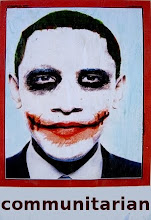
Wednesday, February 4, 2009

There’s More To Fear Than Fear By Fareed Zakaria | NEWSWEEK

Fareed Zakaria, former editor of Foreign Relations (a CFR Journal), is also the author of the more obscure The ABCs of Communitarianism - A Devil's Dictionary in 1996. Zakaria sure knew a lot about communitarianism way before most people in the US. But he assured us the entire concept is nothing more than "politics as usual": "Sometime over the last two years, someone somewhere must have decreed that the intellectual buzzword of the '90s was to be "communitarianism." Only five years ago, communitarianism was an obscure school of philosophy discussed in faculty seminars; today, its ideas are splashed across People magazine and on network TV. "Community" and "civil society," the two mantras of the movement, are part of everyday political discourse.."

At first, I was thrilled to find a "credible" source verifying everything I was writing about communitarianism in 2000. And at that time I was so much a product of the lie that I thought Zakaria was going to help me expose Etzioni! hehe.
There’s More To Fear Than Fear

No, we haven't turned the corner on the banking crisis - we can't even see the corner. What's needed is a bold, massive jolt to the system.

By Fareed Zakaria | NEWSWEEK

Published Jan 24, 2009

From the magazine issue dated Feb 2, 2009

Franklin Delano Roosevelt's first inaugural address is now known for only one sentence: "The only thing we have to fear is fear itself." But the audience at the time paid little attention to that line and the newspapers buried it in their reports the next day. As Jonathan Alter recounts in his book "The Defining Moment," the words that got the greatest applause were something more specific. "I shall ask Congress for the one remaining instrument to meet the crisis," FDR said, "broad Executive power to wage war against the emergency, as great as the power that would be given to me if we were in fact invaded by a foreign foe." The next day's headline in The New York Herald Tribune was FOR DICTATORSHIP IF NECESSARY.

We are not in 1933, and no one would advocate or encourage any such power grab today. But President Barack Obama will have to quickly start planning for a set of more extraordinary measures to pull the United States out of its current, unsustainable economic condition. The president has understandably focused his first few days on important campaign promises - ending torture, closing Guantánamo - but he will now have to tackle the biggest challenge facing the country. {boldface mine}

The American economy is entering its sharpest economic contraction since 1974 - a recession that is likely to be the longest since the Second World War. But that's not the worst of it. The American financial system is effectively broken. Major banks are moving toward insolvency, and credit activity remains extremely weak. As long as the financial sector remains moribund, American consumers and companies - who collectively make up 80 percent of GDP - will not have access to credit, and economic activity cannot really resume on any significant scale. We have not turned the corner. In fact, we can't even see the corner right now. In Washington and in the media, we have all stopped thinking about the rescue of the financial system - that was last year's story - and moved on to the automobile bailout and now the fiscal stimulus. Debates have begun as to whether programs represent pork or investment, whether tax cuts should be preferred to government spending. But despite the injection of hundreds of billions of dollars, and the promise of many billions more, banks are still not lending. Without a functioning financial system, even a massive stimulus will not restore the economy to a normal growth trajectory. Japan tried to jump-start its economy with the world's largest fiscal stimulus in the 1990s. It did nothing for long-term growth in that country.

What about the actions taken so far? The $700 billion TARP, the various federal guarantees, the Federal Reserve's extraordinary actions? The outgoing administration has plausibly claimed that these have worked - in the sense that the financial system has not imploded. Paul Krugman, no fan of the Bush administration's approach to the crisis, acknowledges, "Without the bank bailout, the whole system would have collapsed." But the bailout has not solved the problem; banks are still buried under mountains of bad assets. And while the Bush administration has made mistakes - most of them clearer in hindsight - the Obama economic team knows that there is no simple answer to this extraordinarily complex situation. Britain, which was widely lauded for its first set of bank bailouts, appears to have stumbled in a second set of policies last week. This might be the time to recall screenwriter William Goldman's cardinal rule about Hollywood: "Nobody knows anything."

And yet the government has to do something. President Obama faces a terrible dilemma. He needs to act quickly and on a massive scale. Part of what has unnerved markets has been the incremental nature of the government's response. Will it bail out this bank or that one? On what terms? A broad systemic approach commits the government to one course - one solution - and does not allow for experimentation. It is also enormously expensive. And yet without large-scale action, the financial system will keep bleeding. The politics of this are even worse. The American public believes that we have already spent far too much money on bailing out the banks. But the economic fact is that we have not spent enough. Without several hundreds of billions of dollars, these organizations will remain zombies and the economy will remain paralyzed.

Speed is also crucial. In U.S. policy-making circles in the 1990s it was customary to deride the Japanese government for its weak response to the bursting of Japan's real-estate and stock-market bubble - which led to more than a decade of economic stagnation. In fact the Japanese took drastic action: they injected capital into their banks, lowered interest rates and undertook a massive fiscal stimulus. But they waited for a couple of years before confronting their problems and that made the measures far less effective. The Federal Reserve has learned its lesson and has moved much faster than did the Bank of Japan. But will the American political system move any faster than the Japanese political system?

GET PUBLIC: A THREE HOUR VENUE FOR YOU, by Nancy Levant

Paul Walter, editor of the online magazine News With Views will be a guest, February 7, on internet radio show Govern America, with hosts Darren Weeks and Nancy Levant.

GET PUBLIC: A THREE HOUR VENUE FOR YOU

By Nancy Levant
February 4, 2009
NewsWithViews.com
http://www.newswithviews.com/Levant/nancy118.htm

Somebody (Pete?) sent me down this accounting path a while back, and I did go look up Alaska's budget as Devvy writes about in her last article. This may be something people new to NWO research can sink their teeth into. I know many people are not interested in having to study philosophy and difficult political and legal theory. Following the money is fairly easy when it's a govt agency and can prove to be extremely damaging to the planners. Government (and employees) financial records are all open to public scrutiny.

ARE THE STATES REALLY BROKE OR HIDING ASSETS?

By: Devvy
February 3, 2009
© 2008 - NewsWithViews.com
http://www.newswithviews.com/Devvy/kidd432.htm

And is there anyone now who hasn't heard what the state of New Hampshire is considering? http://votetags.info/2009/02/new-hampshire-throwing-down-the-gauntlet-to-the-federal-government/

Tuesday, February 3, 2009

The Neo-Yeltsin Administration? The Obama Letdown By MICHAEL HUDSON

Michael Hudson wants us to think there is a difference between communitarian civil and criminal law and communitarian economics. He actually tells us domestic policy and legal restructuring at the local level is a "welcome change." He doesn't mention the philosophy, so the communitarian theory for the restructuring never comes up. But he does tell us "Institutional economic and political structures are the key."

If the American people never know communitarian law is the basis for environmental law, and they never know that communitarian law is the "more civil rule of law," then it stands to reason they will also never know that the Federal Reserve Act of 1913, the Administrative Procedures Act of 1946 and everything Wall Street has done to the global economy ever since, was, and is, all based in communitarian economics.

We are never supposed to see the connection between foreign banks, foreign courts, foreign policies and programs, foreign merchants, foreign wars, foreign presidential advisors and the completely insane and incomprehensible foreign philosophical theology that frames the current "debates." We're supposed to see the current financial crisis as some highly academic level topic that we can only hope our leaders can fix. Leading expert economists continue to lead us further and further away from what's really going on here.

The emegering global system is ONE system. The new world orderly financial system and the new global-to-local community oriented domestic policing policies are part and parcel of one big global land management action plan. "A welcome change?" To whom? This article infuriates me. To only target Obama's Yeltsin-like financial rescue is misleading, but to go further than just ommission, to place the new UN LA21 Soviet style civil law in a better light while removing it (rather adroitly) from the main global supremacy of communitarian law ideology is disinformation.
(2) Obama's economic appointees cast him as "Neo-Yeltsin" - Michael Hudson

http://www.counterpunch.org/hudson11262008.html

November 26, 2008
The Neo-Yeltsin Administration?
The Obama Letdown


By MICHAEL HUDSON

Reality had to raise its ugly head. Barack Obama was elected with overwhelming approval to inaugurate an era of change. And at his November 25 press conference, he said that his decisive victory gave him a mandate to change the direction in which America is moving. But his recent economic and foreign policy appointments make it clear that when he chose "change" as his campaign slogan, he was NOT referring to the financial, insurance and real estate (FIRE) sectors, nor to foreign policy. These are where the vested interests concentrate their wealth and power. And change already has been accelerating here. Unfortunately, its direction has been for the top 1% of America's population to raise their share of in the returns to wealth from 37% ten years ago to 57% five years ago and an estimated nearly 70% today.

The change that Mr. Obama is talking about is largely marginal to this wealth, not touching its economic substance – or its direction. No doubt he will bring about a welcome change in race relations, environmental regulations, and a more civil rule of law. And he probably will give wage earners an income-tax break (thereby enabling them to keep on paying their bank debts, incidentally). As for the rich, they prefer not to earn income in the first place. Taxes need to be paid on income, so they take their returns in the form of capital gains. And simply avoiding losses is the order of the day in the present meltdown. [boldface mine}

Where losses cannot be avoided, the government will bail out the rich on their financial investments, but not wage earners on their debts. On that Friday night last October when Mr. Obama and Mr. McCain held their final debate, Mr. Obama was fully on board with the bailouts. And this week's appointment of the "Yeltsin" team who sponsored Russia's privatization giveaways in the mid-1990s – Larry Summers and his protégés from the Clinton's notorious Robert Rubin regime – shows that he knows his place when it comes to the proper relationship between a political candidate and his major backers. It is to protect the vested interests first of all, while focusing voters' attention on policies whose main appeal is their ability to distract attention from the fact that no real change is being made at the economic core and its power relationships.

This is not what most people hoped for. But their hopes were so strong that it was easier to indulge in happy dreams and put one's faith in a prince than to look at the systemic problems that need to be restructured in order for real change to occur. Individuals do not determine who owes what to whom, who is employed by whom or what laws govern their work and investment. Institutional economic and political structures are the key. And somehow the focus has been on the politics of personalities, not on the economic forces at work.

This is as true abroad as it is in the United States. Two weeks ago I was at an economic meeting on "financialization" in Germany. Most of the attendees with whom I spoke expressed the hope – indeed, almost a smug conviction – that Obama would be like Gorbachev in Russia: a man who saw the need for deep structural change but chose to bide his time, seeming to "play the game" with the protective coloration of going along, but then introducing a revolutionary reform program once in office.

Instead, after resembling President Carter by running a brilliant presidential primary campaign to win the nomination (will a similarly disappointing administration be about to come?), Obama is looking more like Boris Yeltsin – a political umbrella for the kleptocrats to whom the public domain and decades of public wealth were given with no quid pro quo.

Obama's ties with the Yeltsin administration are as direct as could be. He has appointed as his economic advisors the same anti-labor, pro-financial team that brought the kleptocrats to power in Russia in the mid-1990s. His advisor Robert Rubin has managed to put his protégés in key Obama administration posts: Larry Summers, who as head of the World Bank forced privatization at give-away prices to kleptocrats; Geithner of the New York Fed; and a monetarist economist from Berkeley, as right-wing a university as Chicago. These are the protective guard-dogs of America's vested interests.

If you are a billionaire, your first concern is simply to preserve your wealth, to avoid having to take a loss in the value of your financial claims on the economy – claims for repayment of loans and investment, as well as interest and dividends, and enough capital gains to compensate for the price inflation that erodes the spending power of more lowly income-earners.

This year has changed the typical fate of financial wealth in the face of bursting financial bubbles. Traditionally, business booms culminate in a wave of bankruptcies that wipe out bad debts – and the savings that have been invested on the "asset" side of the balance sheet. This year has changed all that. The bad debts are being kept on the books – but transferred from the banks to the federal government, mainly the Federal Reserve and Treasury. The bank bailouts have aimed not so much to protect the banks themselves, but to enable them to pay off on the bad bets they made vis-à-vis the nation's hedge funds and other institutional investors in the derivatives market.

To participate in a hedge fund, one needs to prove that one can afford to lose their money and not be much the worse off for it in terms of actual living conditions. So the $306 billion in federal guarantees of the junk mortgage packages sold by Citibank, and the $135 billion bailout of the insurance contracts written by A.I.G. to protect swap contracts from loss, could have been avoided without much impact on the "real" economy.

In fact, writing down these financial claims ON the economy would have paved the way for writing down its debt burden. If the subprime and other mortgage debts had been permitted to decline to the neighborhood of 22 cents on a dollar they were trading for, this would have made it possible to write down debts to match the price at which mortgage holders had bought these loans for. But the financial overhead of American wealth "saved" in the form of creditor claims on indebted homeowners, industrial companies and junk-insurance companies such as A.I.G. has been protected against erosion by this year's federal bailout program.

Bloomberg has added up these programs and finds that they $7.7 trillion dollars – nearly half an entire year's GDP. By acting to support the market for bad-mortgage loans (but not for real estate itself), the seemingly endless series of Paulson bailouts seeks to be to keep today's debt overhead intact rather than writing it down. Service charges on this indebtedness will divert peoples' income from consumption to paying creditors. It will help financial investors, not labor or industry. It will keep the cost of living and doing business high, preventing the U.S. economy from working its way out of debt by becoming competitive once again.

With all these trillions of dollars of bailing out the wealthy, one might easily forget to ask what is being left out. For one thing, the government's Pension Benefit Guarantee Corp, whose $25 billion deficit is not bailed out. This year, underfunded corporate pension plans are supposed to "catch up" to full funding so as to protect the PBGC, in accordance with a law passed by Congress two years ago. If underfunded plans don't meet the scheduled 92% coverage for this year, they have to bring their set-asides fully up to the 100% funding level. The stock market plunge has dashed their hopes to do this. The result will be to force many industrial companies into a financial bind.

On the auto front, the Bush Administration has brought pressure to force the big three Detroit companies into bankruptcy as a way to annul their defined-benefit pension plans – with no plans at all bail out money owed to labor by restoring the PBGC to solvency. State and local pension plans are almost entirely unfunded, and are at even more risk as their tax revenues plunge and property tax payments are stopped on housing and commercial buildings that have foreclosed.

And speaking of state and local finances, what role is local government to play in Mr. Obama's promise to rebuild infrastructure, headed by transportation? Given their strapped position, one is hearing a surge of Wall Street plans to spend enormous sums. Whereas Obama's economic team made fortunes for Russian kleptocrats by giving them public-sector assets already in place, their American counterparts are going to have to get rich by actually building new projects. In such cases the benefits are as large as the total amount of money being spent – but not in the way that most people understand at first glance. Construction contracts for new public transport systems, bridges and roads and urban or rural modernization may be entirely honest and provided at a fair cost. But it is a byproduct of such investment that it creates an amount that is of equal or often even greater magnitude in the form of rent-of-location – that is, vast windfall gains for well-located real estate.

This is where Mr. Obama's Chicago political experience comes in so handy. It is in fact a game tailor-made for his team. Hundreds of millions of dollars were made in gentrifying Chicago's notorious but conveniently centrally located public housing for low-income families. The developments sponsored by Mr. Obama's mentors, the Pritzker family, the University of Chicago and assorted real estate reverends opened up vast new land sites, with public support to boot. (The house where I grew up in Hyde Park-Kenwood, a block or so from Mr. Obama's house, was torn down along with the rest of the entire block as part of Mayor Daley's urban renewal program in the late 1950s – after the University's block busters had run down the neighborhood, then panicked the whites into selling to the blacks at extortionate price markups and mortgage rate premiums, then tearing down the houses into which the blacks had moved. It's an old real estate game that one learns quickly in Chicago politics.) As Thorstein Veblen noted, any American city's politics is best understood by viewing it as a real estate development.

The gains from providing better transport infrastructure typically are so large that transportation investment could be self-financing by taxing these property gains – recapturing the added rental value in the form of property windfall taxes. London's tube extension to Canary Wharf, for example, cost the city £8 billion – but increased real estate values along the route by some £13 billion. The city could have financed the entire project by issuing bonds that would have been repaid out of taxes levied on the windfall gains created by this public expenditure.

Likewise in New York City, the transport authority has just announced that subway and bus fares will be jacked up (adding no less than $10 to the monthly commute card) and services cut back sharply. Mayor Bloomberg has just stopped work on the 2nd Avenue subway, its completion will add at least as much to upper East Side property values as the subway costs itself. The city thus could finance its construction not by issuing bonds to be paid off by city and state taxpayers in combination with user fees paid as fares. Taxpayers wouldn't have to pay, and riders could enjoy subsidized fares simply by taxing the real estate owners.

But I see no prospect of this being done. Real estate is still the name of the game, because it remains the largest asset category in every economy today just as much as under feudalism. The difference from feudalism is that whereas landlords received the rental value of their lands in centuries past, today's property owners acquire ownership not by military conquest (the Norman invasion of 1066 in England's case) but by borrowing from the banks. To a mortgage banker, a commercial developer or real estate company is a prime customer, the bulwark of bank balance sheets. It is hard to imagine a new American infrastructure program not turning into a new well of real estate gains for the FIRE sector. Real estate owners on favorably situated sites will sell out to buyers-on-credit, creating a vast new and profitable loan market for banks. The debt spiral will continue upward.

The fact that state and local budgets are too burdened to afford infrastructure spending themselves will lead to it being privatized from the outset. Probably London's notorious public-private partnerships (a Labour Party refinement more Thatcherite than even Margaret Thatcher herself could have got away with) probably will become the basic model. Users will pay higher fees rather than enjoying the subsidized or free access typical in public infrastructure spending during the Progressive Era. The main purpose of public enterprise back then was to keep prices down for basic services, thus lowering the cost of living and doing business in America. But today, infrastructure spending will be just one more item adding to America's debt overhead to make its economy even less competitive with foreign ones than it is.

The moral is, next time a candidate promises change, ask him to say just what changes he has in mind. During the Presidential debates, only Dennis Kucinich came out and said each specific law that he had put before Congress to implement each change he promised. But most of the public didn't want to know the details – they simply liked hearing the word "change."

Here are some purely fiscal and financial changes that a future presidential candidate might propose – changes that I don't expect to be hearing any more about during the next four years. Just to get the discussion going, why shouldn't these merely marginal changes within the existing system be implemented right now by a presidential candidate who is still bragging about his "mandate for change":

* Regarding fiscal policy, re-introduce the estate tax, along with (at the very least) the Clinton era's progressive-tax schedule.

* Tax capital gains at the same rate as wages and profits, rather than at half the rate; and make these taxes be paid at the point of sale of real estate or other assets, not deferred ad infinitum if the gains simply are invested in yet more wealth.

* Require a cost-benefit analysis of any publicly backed infrastructure spending so as to recapture all "external economies" (such as windfall real estate price gains) as the first line of financing such investment.

* Tax corporate borrowing that is used merely to pay stock dividends or buy back one's own stock at least at 50%.

* Close the practice of offshore tax avoidance, and bring criminal cases against accounting firms abetting this practice.

* Only let a building be depreciated once, not repeatedly as a tax writeoff.

* Refocus state and local taxation on the property tax, remembering that whatever the tax collector relinquishes is simply "freed" to be paid to the banks as interest.

* In the sphere of bad-debt banking, when a government agency takes over a bank or company that has negative net worth, the stockholders must be wiped out as their stock has lost all market value. Bondholders must stand in line behind the government in case of insolvency.

* Write down mortgage debts to the ability of property owners to pay and/or the present market value. Banks that have made loans to these borrowers must take responsibility for their decision that the owners could afford to pay. Even better, apply New York State's existing Fraudulent Conveyance law, and simply annul loans that are beyond the ability of debtors to pay.

None of this involves real structural change. It is simply more economically efficient under existing laws and practices – something like actually enforcing environmental law, anti-fraud and anti-crime laws, and the original intent of our tax legislation. It is a small step back toward the Progressive Era a century ago – the era that set America on the path of prosperity that made the 20th century the American century.

Michael Hudson is a former Wall Street economist. A Distinguished Research Professor at University of Missouri, Kansas City (UMKC), he is the author of many books, including Super Imperialism: The Economic Strategy of American Empire (new ed., Pluto Press, 2002) He can be reached via his website, mh@michael-hudson.com

ICC Prosecutor looks at ways to put Israeli officers on trial for Gaza 'war crimes'

The Israeli-Hamas conflict is synthesizing. Establishing jurisdiction is a key element in all court procedures, it's the process where a court confirms or denies their authority to hear and rule on a case. To date, neither the U.S. or Israel recognise the International Criminal Court's (ICC) jurisdiction over them. The Palestinian Authority has not been recognised by any nation as sovereign state. While the U.S. government was quick to recognise the Bolsheviks in Russia and the Jewish Israeli revolutionaries "right of return" to Palestine, official U.S. recognition of the Arab-Muslim Palestinian state is non-existent.

In the U.S., the accepted, "unofficial" attitude toward the Palestinian people is that they are all a bunch of fanatical whacked out Jihad terrorists who threaten Israel's (and America's) existence. To be pro-Palestinian rights in the U.S. is considered anti-Semitic by the ADL. One doesn't even have to be a gentile or in favour of eliminating Israel to be accused of anti-Semitism. According to the ADL, anyone speaking out against Israel is guilty of anti-Semitism and can/should be charged with a hate crime. As the ADL's (established in 1913, the same year the international bankers got the Federal Reserve Act passed) U.S. tax funded presence on the internet gains them more power to crush all U.S. opposition opinions, it will also create an international backlash against them. The way I see it, the ADL's assumption of dictatorial control over published content also plays right into the hands of the people who want to give the ICC more power.

There were 2 articles about this in Peter Myer's email forward, but, as usual, the UK press article includes more relevant information:

(2) ICC is exploring ways to prosecute Israeli commanders over Gaza

From: IHR News <news@ihr.org> Date: 04.02.2009 03:51 PM

Prosecutor looks at ways to put Israeli officers on trial for Gaza 'war crimes'

Catherine Philp in Davos and James Hider in Jerusalem

http://www.timesonline.co.uk/tol/news/world/middle_east/article5636069.ece

From The Times

February 2, 2009

The International Criminal Court is exploring ways to prosecute Israeli commanders over alleged war crimes in Gaza.

The alleged crimes include the use of deadly white phosphorus in densely populated civilian areas, as revealed in an investigation by The Times last month. Israel initially denied using the controversial weapon, which causes horrific burns, but was forced later, in the face of mounting evidence, to admit to having deployed it.

When Palestinian groups petitioned the ICC this month, its prosecutor said that it was unable to take the case because it had no jurisdiction over Israel, a nonsignatory to the court. Now, however, Luis Moreno-Ocampo, the ICC prosecutor, has told The Times that he is examining the case for Palestinian jurisdiction over alleged crimes committed in Gaza.

Palestinian groups have submitted arguments asserting that the Palestinian Authority is the de facto state in the territory where the crimes were allegedly committed.

“It is the territorial state that has to make a reference to the court. They are making an argument that the Palestinian Authority is, in reality, that state,” Mr Moreno-Ocampo told The Times at the World Economic Forum in Davos.

Part of the Palestinian argument rests on the Israeli insistence that it has no responsibility for Gaza under international law since it withdrew from the territory in 2006. “They are quoting jurisprudence,” Mr Moreno-Ocampo said. “It’s very complicated. It’s a different kind of analysis I am doing. It may take a long time but I will make a decision according to law.”

Mr Moreno-Ocampo said that his examination of the case did not necessarily reflect a belief that war crimes had been committed in Gaza. Determining jurisdiction was a first step, he said, and only after it had been decided could he launch an investigation.

The prosecutor’s office has already received several files on alleged crimes from Palestinian groups and is awaiting further reports from the Arab League and Amnesty International containing evidence gathered in Gaza.

Under the Rome treaty that founded it, the ICC can investigate and prosecute allegations of the most serious war crimes only if the country responsible is unwilling or unable to do so through its national courts.

States that are party to the treaty can refer cases of crimes committed by their citizens or on their territory. Cases involving the citizens or territory of a country that has not signed up to the court can be referred by the United Nations Security Council – as in the case of Darfur. Ivory Coast set a precedent as the first nonstate party to accept the ICC’s jurisdiction over alleged war crimes on its territory. It signed the Rome treaty but never ratified it. In 2005 it lodged a declaration with the court accepting the ICC’s jurisdiction over crimes committed there since September 2002.

Palestinian lawyers argue that the Palestinian Authority should be allowed to refer the cases in Gaza on this same ad hoc basis – despite its lack of internationally recognised statehood.

The case has wide-reaching ramifications for the Palestinian case for statehood. If the court rejects the case, it will highlight the legal black hole that Palestinians find themselves in while they remain stateless. However, it also underlines some of Israel’s worst fears about a Palestinian state on its borders. A Palestinian state that ratified the Rome treaty would then be able to refer alleged Israeli war crimes to the court without the current legal wrangling. The case could also lead to snowballing international recognition of a Palestinian state by countries eager to see Israel prosecuted.

One avenue would be for Israel to agree to investigate its commanders and prosecute any crimes discovered. That would remove any case from the orbit of the international court. So far that appears unlikely, given Israel’s repeated denials of war crimes in Gaza.

The Israeli army has, however, launched an internal inquiry into whether white phosphorus was used in some cases in built-up areas, having eventually admitted that it did use the incendiary substance, which is not illegal as a battlefield smokescreen but is banned from being used in civilian areas. Camera footage from one such attack shows what appears to be white phosphorous raining down on a UN school in Beit Lahiya, where Red Crescent ambulances and their crews were stationed.

A coalition of Israeli human rights groups has urged the country’s attorney-general to open an independent investigation into allegations of war crimes by troops, urging that to do so could head off international court cases. The groups, including the antisettlement organisation B’Tselem, said that there had been reports of Israeli forces firing into civilian areas, denying medical aid to the wounded and preventing Palestinian ambulances from reaching them, and of firing at people carrying white flags.

Meanwhile, the UN is preparing an inquiry into the bombardment of a UN school in Jabaliya, in the northern Gaza Strip. Israeli forces fired artillery shells outside the school, which had been converted into a refugee shelter for Gazans fleeing their homes. At least 43 people were killed. Israel said that Palestinian militants had fired from the compound, which was denied by the UN.

Sunday, February 1, 2009

Camp Redington - winter camping in Alaska!


Camp Redington

Winter camping in Alaska!

Following rabbit tracks

down the rabbit hole

new outhouse by tent spaces

Snowmachine trails throughout the camp

8x10 rental cabin with trails outside door

The changing face of Gerteeville

Obama facing dilemma over protectionism

Here's a neat twist. Obama is being attacked in the left wing press for the Patriot Employers Act. Is it possible that American Democrats have a plan to subvert our free trade agreements with Canada and Australia? (Will this lead to a "stronger" contract/court of law in future agreements?) The Act includes using American made steel for the big public works programs Obama is planning. What could be the purpose of that for people openly committed to communitarian principles?

How likely is it that Obama is really a protectionist? Didn't Putin just warn the world against this very thing in his speech at the World Economic Forum? What is protectionism in the US? Who does it protect? How did economist Friedrich List describe it in 1846? Is there any remnant of 19th century protectionism in this Act? And as horrible as this sounds, didn't Hitler also combine his socialism/fascism with protectionism and call it National Socialism? I'm thinking the idea of a protected local economy is a great sell to the general public anywhere, especially to ones who thinks it means local goods and services will benefit from local made and local hire conditions. I've never met an Alaskan who wasn't happy with the local hiring laws up here. I think this Act will contribute to Obama's image in the US, and give the internationalists a great topic for their circular academic debates.
(9) Obama facing dilemma over protectionism

http://www.google.com/hostednews/ap/article/ALeqM5i4s37Co-txUki3IUqyBr7vLSbr3AD96291VO0

Obama facing dilemma over protectionism

By DESMOND BUTLER

Associated Press January 31, 2009

WASHINGTON (AP) — Protection language in the stimulus bill presents President Barack Obama with a dilemma: Backing the provisions could set off a trade war, but opposing them could mean a backlash from his supporters.

The "buy American" provisions would require major public works projects to favor U.S. steel, iron and manufacturing over imports.

U.S. allies and trading partners warn that favoring U.S. companies would breach Washington's trade commitments and could set off tit-for-tat countermeasures around the world.

The two largest U.S. trading partners have spoken out. On Thursday, Canadian Prime Minister Stephen Harper expressed concern and the European Union warned that it would not "stand idly by" if such measures were passed. On Friday, Brazil's president Luiz Inacio Lula da Silva also made critical comments.

In November, world leaders who gathered in Washington for the G-20 summit to consider how to help the global economy pledged to avoid protectionism. But since taking office Jan. 20, Obama has said little on trade and has yet to nominate a trade representative. While campaigning, he argued that the Bush administration's strong support of free trade agreements should be moderated by including environmental and labor protections.

"The jury is out on how this administration is going on trade policy," said Steven Schrage, an international business analyst at the Center for Strategic and International Studies. "This will be a key test."

Asked about the protective provisions Friday, White House press secretary Robert Gibbs would say only that the administration was reviewing them.

The provisions are likely to find support among Americans outraged that money from a stimulus package likely to top $800 billion could go to foreign competitors of U.S. companies.

"I believe that when taxpayer dollars are used, they should support the things produced here at home," Sen. Byron Dorgan, D-N.D., author of one of the provisions, said in a statement.

Many analysts say the measures reflect the interests of small sectors over the larger economy, which could suffer from reduced trade and higher steel prices.

"The result, according to my calculations, is that the U.S. will lose more jobs than it will gain," said Gary Hufbauer, an economist with the Peterson Institute for International Economics, a Washington think tank. "We are going to poison the wells of world commerce if we do this."

The provisions are in a bill already approved by the House and a different version under consideration in the Senate. The Senate version states that none of the funds from the stimulus may be used for a project "unless all of the iron, steel and manufactured goods used in the projects are produced in the United States." The House version leaves out manufactured goods.

Obama, who has argued that stimulus measures are urgent, is unlikely to block passage of any bill approved by the Congress. But he could press lawmakers to remove the protectionist measures before it is passed.

"The problem is that Obama has not said anything yet," said Dan Ikenson of the libertarian Cato Institute.

Both versions of the bill include language that would allow the president to waive the protectionist measures if he decides that would be in the economic interests of the United States. But passage of the measures could in itself unnerve trading partners and encourage other countries to take similar protective action.
Hosted by

Copyright © 2009 The Associated Press. All rights reserved.

EMTV Interview with Brian Gerrish about Common Purpose

Here's what looks to be like a good video interview of Brian Gerrish, my dialup is so slow I can never watch these. :( How Common Purpose in the UK is connected to the Communitarian Network in the USA at GWU has yet to be directly substantiated with documents or interviews with the members of these organizations. The only way I can see the connection, thus far, is because they share the same philosophy, and the guys at Stop Common Purpose apparently agree with me on this. For many people CP is the "smoking gun" in the UK. From Robert Coones:

http://www.blip.tv/file/1723061